

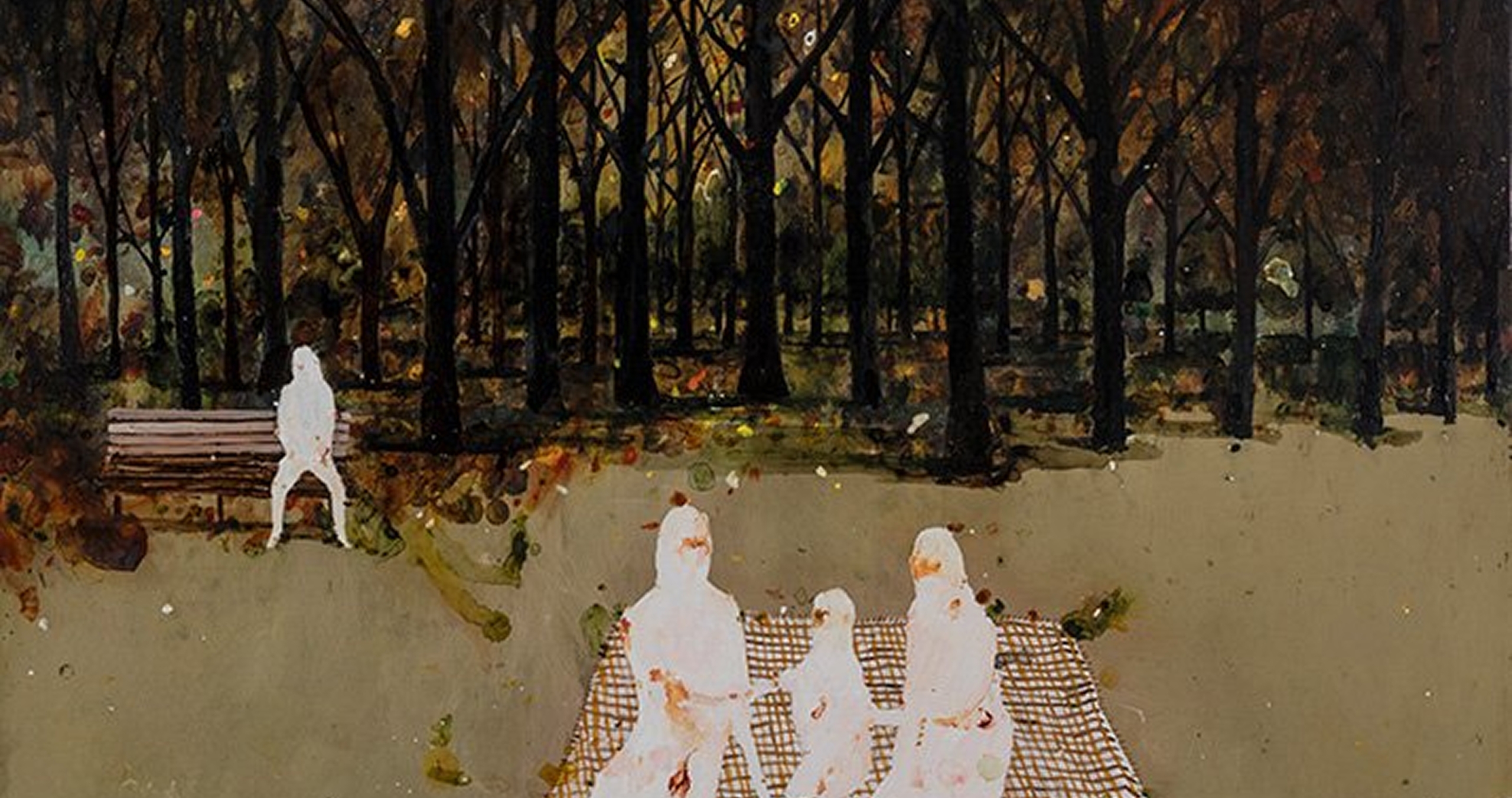
Geelong Contemporary Soiree
Geelong Gallery 2026
Photographer: Tom Smith
History
Established in 1896, Geelong Gallery is one of Australia’s leading and oldest regional art galleries.
Geelong Gallery was established in 1896 and is one of Australia’s leading art galleries, with a magnificent collection of Australian and European painting, sculpture, printmaking and decorative arts dating from the 18th century to today. The Gallery’s outstanding collection includes many works of national significance such as Eugène von Guérard’s View of Geelong 1856, and Frederick McCubbin’s A bush burial 1890. One particular focus of the collection is early images of the Geelong region, documenting the evolution of this important city and its environment.
Geelong Gallery works to contribute to the life and well-being of the city by fostering strong community engagement with the excellence of its collection, its creative lifelong learning experiences, and inspiring exhibitions.
G L Massingham
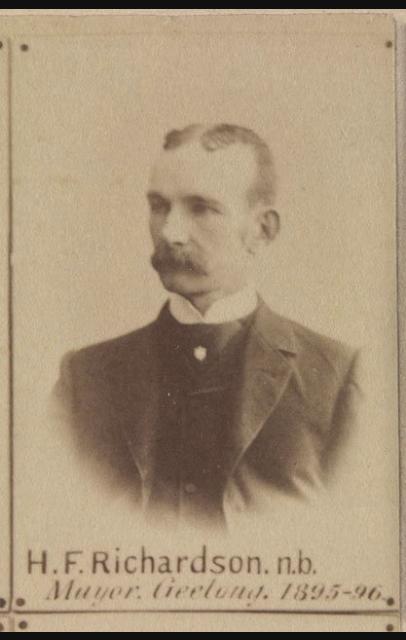
H.F. Richardson, n.b. 1896
albumen silver photograph
State Library Victoria
1896
Geelong Gallery was established in 1896 by prominent Geelong citizens and business leaders, who advocated for Geelong’s growth. They were known as the Geelong Progress League and their first meeting was held on 16 January 1896.
Their proposal for a Gallery for Geelong was presented to Mayor Horace Frank Richardson on Monday 20 January 1896, at 4.00pm, in the Mayor’s room of the Town Hall.
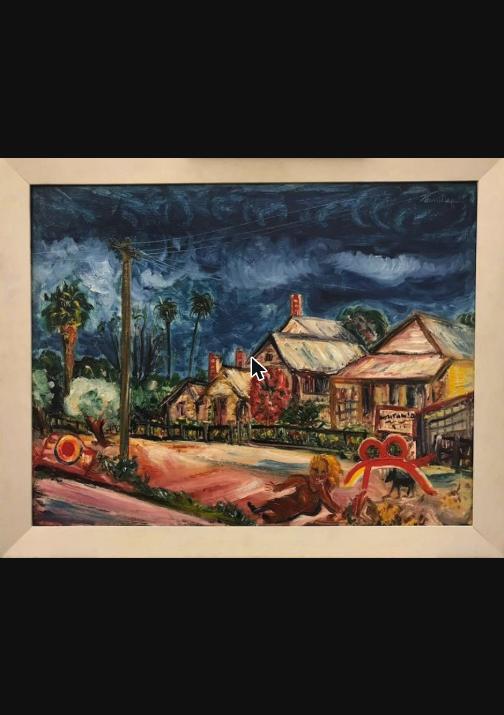
Danila Vassilieff
An accident I saw 1948
oil on board
Geelong Gallery
Gift of the AG Morant Estate, 2005
© National Gallery of Victoria
Photographer: Louise Bradley
1897
Australian painter Danila Vassilieff was born in 1897 in Russia.
His works are an important part of our collection, with his painting An accident I saw being recently picked by our visitors to be preserved through the support of Geelong Conservation.
Unknown photographer
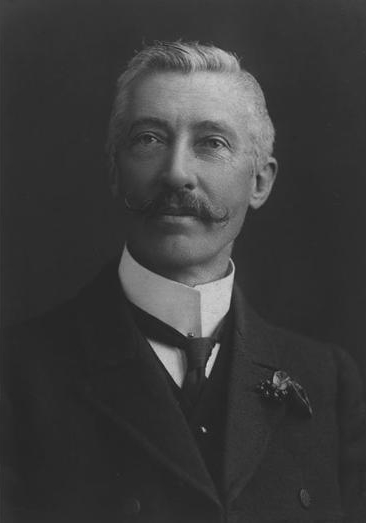
Portrait of James Whitley Sayer c. 1900
black and white photograph
Geelong Gallery archives
1898
In 1898, the Geelong Progress League continued their advocacy for an art gallery for the people of Geelong, but had not yet secured a permanent location.
In the Geelong Advertiser on 26 April 1898, it was mentioned that prominent Geelong citizen James Whitley Sayer had been instrumental in advocating for Geelong Gallery’s existence, yet little progress was made. At the time, the Advertiser expressed concerns and hopes for Geelong Gallery—according to the article, ‘the proposal to start an art gallery in the town had not received much consideration of late, but [Sayer] trusted to see it in existence … ‘.
Sayer was a prominent figure in the establishment of Geelong Gallery, and he was also one of the earliest artists to donate works of art to our collection.
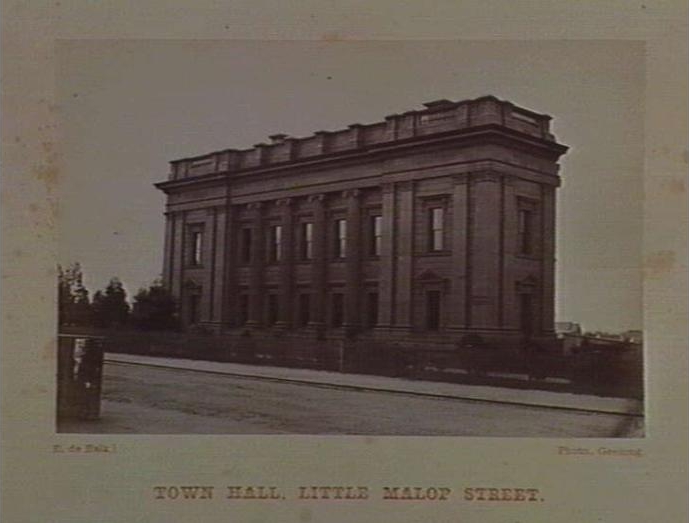
Eugen Wilhelm Ernst De Balk
Town Hall, Little Malop Street [Geelong] 1866
albumen silver photograph
State Library Victoria, Melbourne
1899
In 1899, Geelong Gallery still didn’t have a home, but many landmarks in the region had been proposed.
According to a clipping from The Argus on 23 November 1899, places such as the Fire Brigade Station (Little Malop Street), the Town Hall (Gheringhap Street), and the Free Library (Moorabool Street), had all been considered.
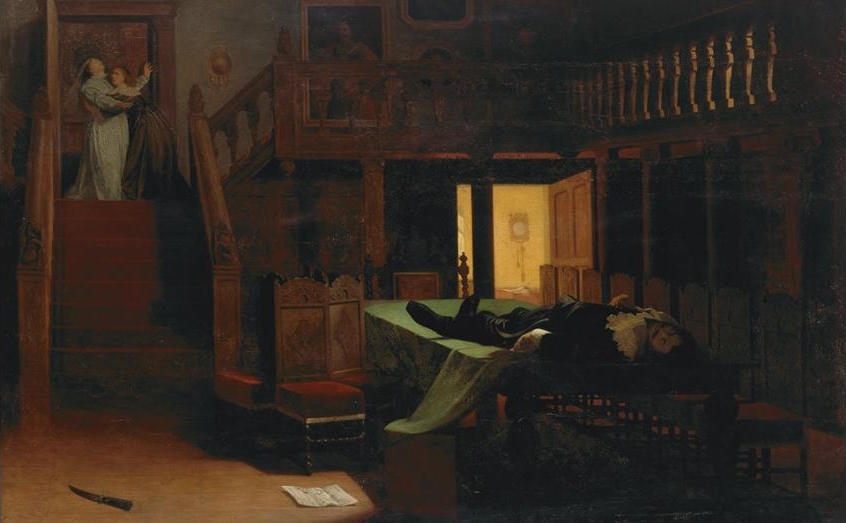
G F Folingsby
[First meeting between Henry VIII and Anne Boleyn] 1879oil on canvas
National Gallery of Victoria, Melbourne
Purchased with a Government grant, 1879
1900
In May 1900, the Geelong Art Gallery Association was given permission to hang works of art on three walls inside the Geelong Town Hall.
They hung 68 works in total. The National Gallery of Victoria loaned nine works (the most substantial contribution to the exhibition), including George Frederick Folingsby’s First meeting between Henry VIII and Anne Boleyn (1879), Louis Buvelot’s Summer evening, Templestowe (1866), Eleanor Bell’s Grandma’s reading lesson (c. 1800), and David Wilkie’s Wynfield Death of George Villiers, Duke of Buckingham (1871).
On 31 May 1900, the formal opening of the Geelong Art Gallery took place at the Town Hall with Mayor William Picken Carr officially declaring Geelong Gallery open to the public.
Despite not yet having a dedicated space, this exhibition marked an important step for Geelong Gallery’s future development.
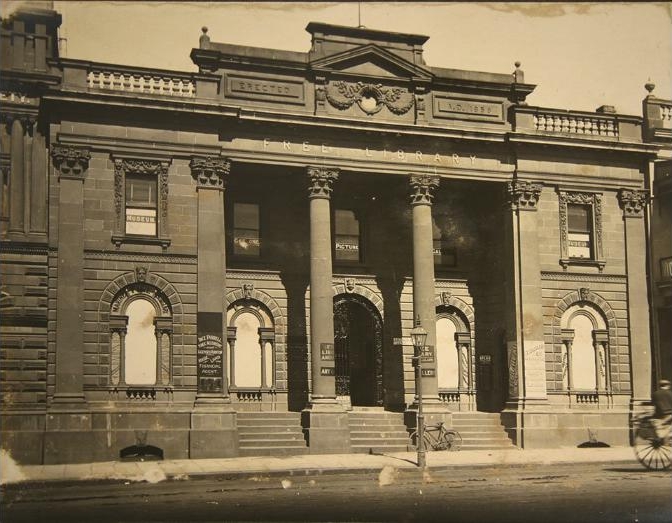
John Henry Harvey
[Free Library and Savings Bank, Geelong] c. 1900photograph
State Library Victoria, Melbourne
J H Harvey collection
1901
By 1901, Geelong Gallery had relocated to a new home. After a few short months at the Geelong Town Hall, the collection was moved out and into a new site. According to reports from the Geelong Advertiser, Geelong Gallery was moved due to the lighting at the Town Hall being ‘altogether unsuitable for their purposes’.
The Geelong Art Gallery Association debated between Gordon College and the Geelong Free Library as their new premises. Gordon College was their first choice, but the space was required for lessons, so the collection was moved to the Geelong Free Library.
Built in 1858 as the Chamber of Commerce, the Free Library was located on Moorabool Street, but was demolished in 1955. It was located roughly where Victoria House is today, in-between the K-Rock radio station and the Westpac Business Bank.
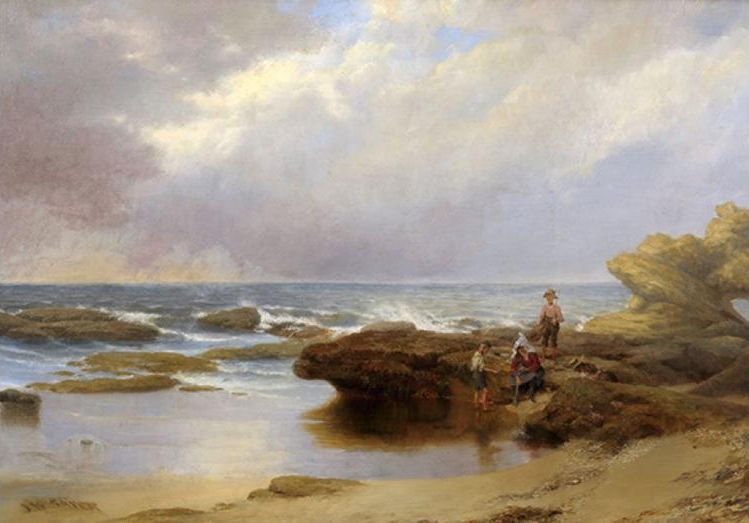
James W Sayer
[The Cowrie Pool, Torquay] 1896oil on canvas
Geelong Gallery
Gift of the artist, 1902
1902
James Whitley Sayer was an integral figure in Geelong Gallery’s establishment, but he was also an incredibly talented artist.
In 1902 he donated his work, The Cowrie Pool, Torquay to the Geelong Art Gallery Association. The Cowrie Pool, Torquay depicts Sayer’s four youngest children on a beach outing at Torquay, where they regularly spent their summer holidays.
This work, like much of Sayer’s works, beautifully captures what we recognise and love about Geelong and the surrounding areas, the landscape.
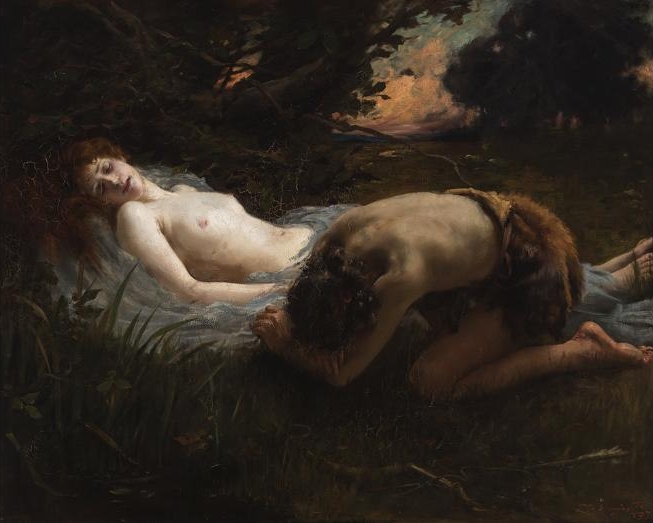
Thomas Kennington
[Cephalus and Procris] 1897oil on canvas
Geelong Gallery
Purchased 1903
1903
In 1903, Geelong Gallery displayed Thomas Kennington’s Cephalus and Procris (1897), which was lent by the British loan collection.
The story of Cephalus and Procris is a mythical romantic tragedy. Cephalus was an Aeolian prince, the son of King Deioneus of Phocis, and Procris was an Athenian princess, the daughter of King Erechtheus of Athens. The two were married and said to be wholly devoted to each other.
The goddess of dawn, Eos, fell in love with Cephalus, and when he wouldn’t leave Procris for her, she kidnapped him while he was hunting. Eos eventually gave him back to Procris due to Cephalus’ constant pining for her.
Although the two were back together, they distrusted each other, constantly questioning their fidelity. This ended up being their undoing. Procris had gifted Cephalus two magical items she acquired from the goddess Diana, a hunting hound that always catches its prey, and a javelin/dart that always hits its target.
One day Procris followed Cephalus into the woods, thinking he was using hunting as an excuse to break his fidelity. She hid in a bush, making a rustle, which Cephalus took for an animal. He threw the magical javelin and accidently killed Procris. This scene is depicted in Kennington’s painting.
Geelong Gallery charged a small admission fee to see the painting, with the intention of raising enough funds to purchase the work, an intention they fulfilled.
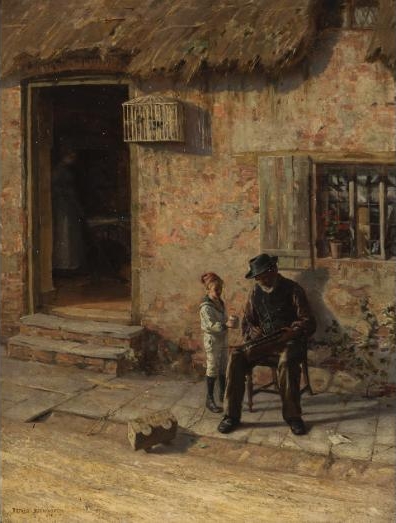
Arthur Burrington
[The village fleet under repairs] 1886oil on canvas
Geelong Gallery
Gift of Howard Hitchcock, 1904
1904
In 1904, Geelong Gallery faced some hardship. In their annual meeting, they found that 1903 had seen significantly fewer attendees than 1902, mainly due to the entrance fee introduced for particular works. In 1903, they recorded 14,305 attendees, which was a third less than 1902.
With attendance low, Geelong Gallery hoped for a bigger share of grant money from the government in 1904. Unfortunately, the state government decided to scrap their art gallery grants, seriously affecting all the galleries in Victoria.
The loss of the government funding cast doubts on Geelong Gallery’s future, with their only hope to improve member subscription to replace the funds lost by the removal of the grant.
Geelong Gallery managed to get by in 1904 without government assistance, but little progress was made in that year without the extra funds. Geelong Gallery was gifted some more works for the collection in that year, including another work from Sir Howard Hitchcock, a consistent and generous donor to the permanent collection in its early years. He donated the pictured work, The village fleet under repairs (1886) by Arthur Burrington.
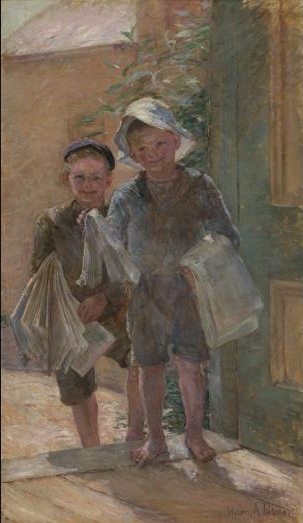
Helen Peters
[The breadwinners] 1903oil on canvas
Geelong Gallery
Purchased 1906
1905
1905 proved to be another tough year for Geelong Gallery, with attendance in 1904 only reaching 13,593. Another year without a government grant was not possible for Geelong Gallery, so the Geelong Art Gallery Association pushed hard for the government to reinstate the art gallery grants.
In addition, Geelong Gallery requested assistance from more established galleries, Bendigo Art Gallery and The Art Gallery of Ballarat. Geelong Gallery was in dire need of a grant to improve the collection, as their annual revenue only just covered the costs of maintenance.
In June 1905, Geelong Gallery received a grant of £25 from the Treasury thanks to Mr. Colechin, a member for Geelong who pushed for the State Treasurer to consider Geelong Gallery for a grant.
After securing the grant, they acquired a host of new paintings by September 1905, including several works loaned by local Geelong artist, Helen Peters. They purchased Peters’ work The breadwinners in December 1905, which quickly became a favourite among visitors.
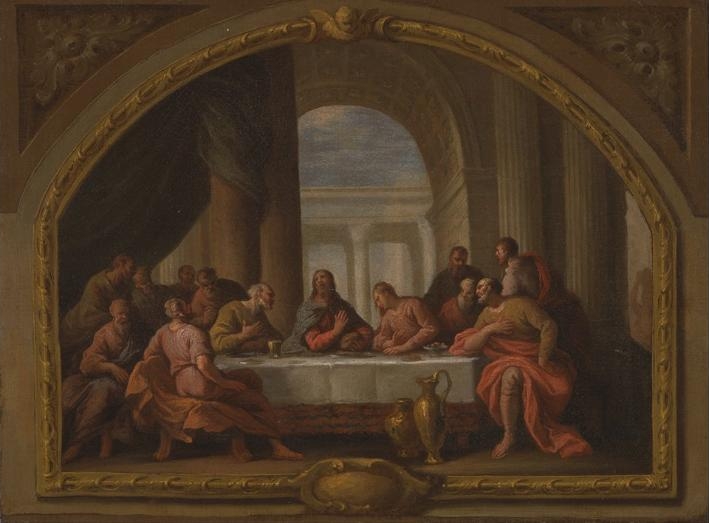
Sir James Thornhill
[Sketch for ‘The Last Supper’] c.1719-1720oil on canvas
Yale Center for British Art
Paul Mellon Collection
1906
1906 was a quiet year for Geelong Gallery, which was still operating out of the Geelong Free Library, eagerly awaiting a permanent location.
Unfortunately during 1906, Geelong Art Gallery Association President Sidney Austin passed away. Austin was a supporter of Geelong Gallery since its inception, and his death was mourned deeply by the Association. His position was filled by another Geelong Gallery supporter, T.S. Hawkes.
Before he passed, however, Austin and the Geelong Art Gallery Association secured the loan of Sketch of ‘The Last Supper’ by James Thornhill, a reproduction of the famous work by Leonardo Di Vinci. Thornhill’s version depicts the same event, but rearranges small details, such as Christ’s hands and the positions of the twelve disciples.
This small but intriguing work hung for several weeks at the Art Gallery of Ballarat, where it attracted thousands of visitors. The work then arrived in Geelong and attracted around 5200 visitors. Sketch for ‘The Last Supper’ is now housed at the Yale Center for British Art in Connecticut, USA.
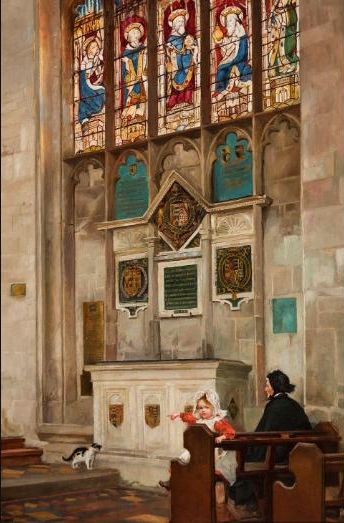
Julia Meyer
[The church cat] 1907oil on canvas
Geelong Gallery
Purchased 1907
1907
Throughout 1907, advocating for a permanent location continued to be of primary concern—a goal the Geelong Art Gallery Association had now been working towards for over ten years.
Towards the end of the year new works were acquired, including The church cat by English artist Julia Meyer. Meyer had exhibited the work at the Royal Academy of Art, London, where it was purchased for the Geelong Gallery for £15 by Oscar Ferdiand Armytage.
Meyer’s work captures a cat in a church alongside a woman and a child. The intimate connection between the figures is juxtaposed by the grandiose architecture of the church, the scene combining elements of the sacred and the everyday.
1908
In 1908, Geelong-born artist Arthur Streeton painted Santa Maria della Salute while on honeymoon in Venice, Italy.
Streeton’s work depicts the city’s famous domed basilica of Santa Maria della Salute, located on a narrow strip of land where the Grand Canal meets the Bacino di San Marco.
Arthur Streeton was born in 1867 in Mount Duneed, south-west of Geelong. There is a memorial commemorating Streeton’s life on the corner of the Princes Highway and Ervin’s Rd, Mount Moriac.
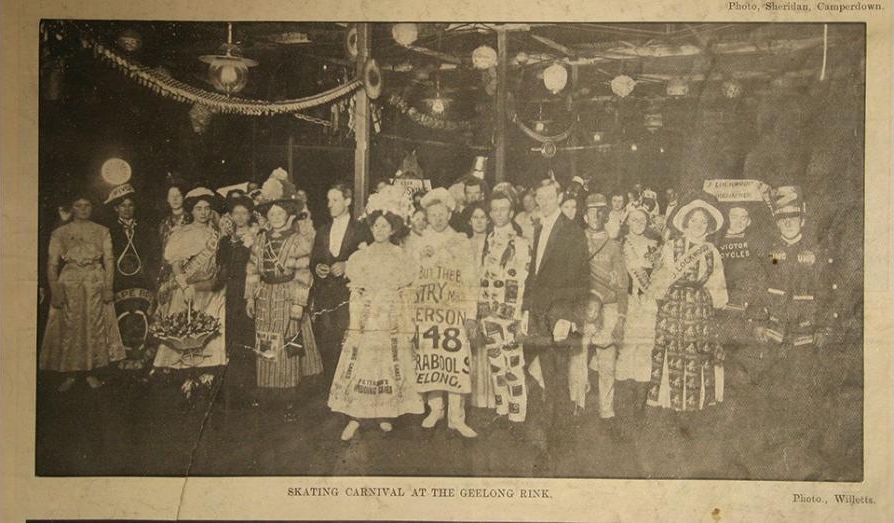
Skating carnival at the Geelong rink, 1909
Geelong Heritage Centre
1909
In 1909, the Geelong Gallery hosted a roller skating carnival on the showroom floor of Dalgety’s and Co. Wool Warehouse (now Deakin University) to raise funds for the construction of a permanent site.
The carnival saw great attendance, with roughly 1,500 guests, 300 of whom were skating. It was requested that skaters wear fancy costumes, and many did, much to the delight of onlookers. Costumes included stockmen, troubadours, cavalrymen, clowns, and even life-size Havelock cigarettes packets.
There are no known images from this event, but the Geelong Heritage Centre have sourced an image of some costumed skaters at the old Geelong Skating Rink.
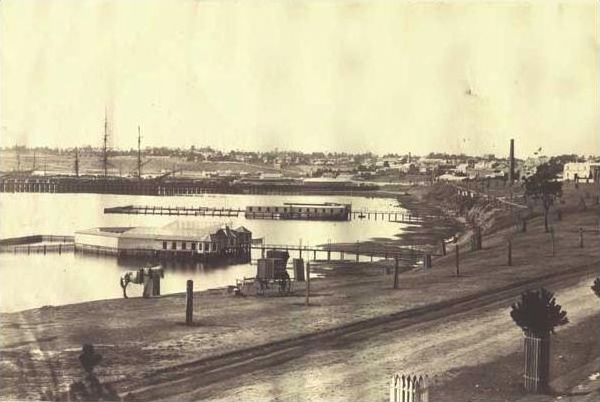
Fred Kruger
Geelong Harbour, from Western Beach 1880–87
albumen silver photograph
Geelong Gallery
Purchased 2009
1910
Geelong was officially declared a city in 1910. Geelong was known as an industrial city due to the various woollen mills, Ford Motor Company and the Corio Whiskey Distillery. The word Geelong was derived from the Wadawurrung name for the region Djillong, which means ‘tongue of land’.
This image by Fred Kruger was photographed in the 1880s and shows the Western Beach foreshore at the time.
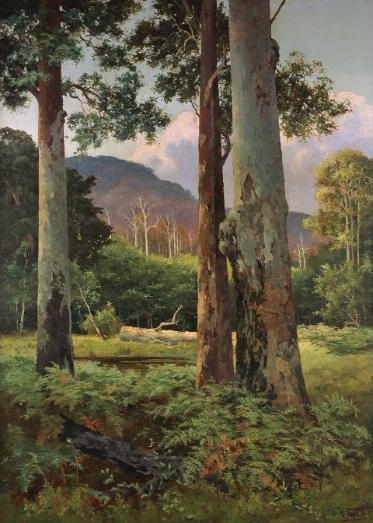
Henri Tebbitt
Old Australian giants c. 1900
oil on canvas
Geelong Gallery
Gift of the Estate of FS Grimwalde, 1911
1911
In 1911, the Geelong Art Gallery Association’s proposal for a permanent site to be built next to the Geelong Town Hall was approved.
1911 was a year of stabilisation and growth for Geelong Gallery. Finances were steady, visitation was improving, and the permanent collection had significant acquisitions.
At this time, the permanent collection consisted of 38 oil paintings, 18 watercolours and eight sculptures. Included in this early group of works is Old Australian giants by Henri Tebbitt, a striking image of our most recognisable native flora, the gum tree. Tebbitt’s painting represents the heart of the bush, motivating viewers to observe and admire the natural beauty of the Australian landscape.
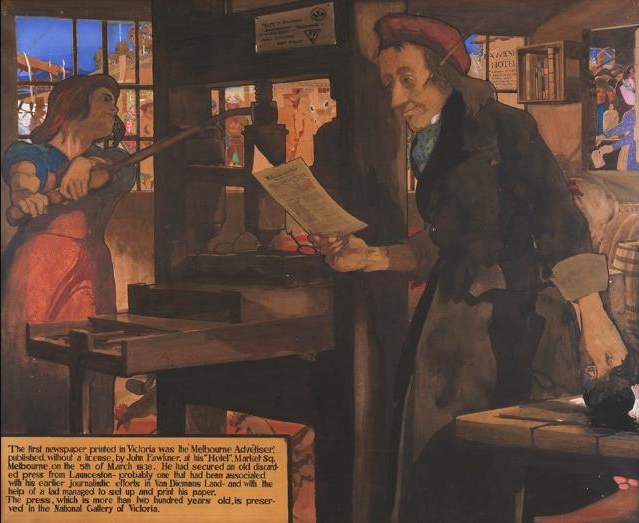
Blamire Young
Fawkner and his press 1901
watercolour
Geelong Gallery
Gift of GM Hitchcock, 1903
1912
In 1912, long time supporter and founding member of the Geelong Art Gallery Association, George Michaelmore Hitchcock, passed away.
Hitchcock was a prominent politician, businessman and philanthropist in Geelong who contributed several works to the permanent collection. Among these works was Fawkner and his press and Buckley acting as interpreter at Indented Head by Blamire Young, acquired in 1903.
In recognition of the significant contributions Hitchcock made to the cultural life of the City, the Geelong Art Gallery Association started to raise funds towards the construction of the G M Hitchcock Memorial Art Gallery.
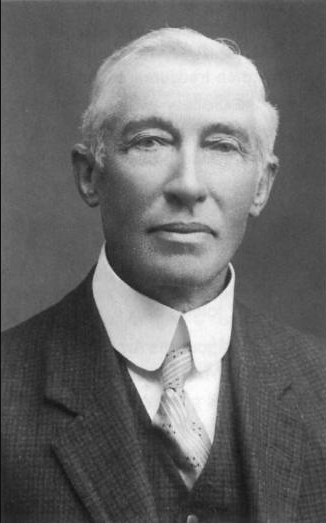
Laird and Buchan
Proposed GM Hitchcock Memorial Art Gallery, c. 1913
Geelong Gallery Archives
1913
In 1913, the Geelong Art Gallery Association confirmed the design for the G M Hitchcock Memorial Art Gallery. Six architectural designs for the proposed gallery were submitted.
They decided on a £3000 design by prominent Geelong architects, Angus Laird and Thomas Johnston Buchan.
After Angus Laird died in 1936, Buchan founded the firm Buchan, Laird and Buchan with Laird’s son Ewen, and his own son John. The trio designed many Geelong landmarks such as Geelong Hospital, Geelong Grammar School, and Eastern Beach Pavilion.
Featuring a glazed roof and classical architectural ornamentation, the G M Hitchcock Memorial Gallery is one of the most recognisable spaces within Geelong Gallery. As the first section of the building to be constructed, it endures as a fitting memorial to a Geelong citizen who worked tirelessly for the establishment of Geelong Gallery.
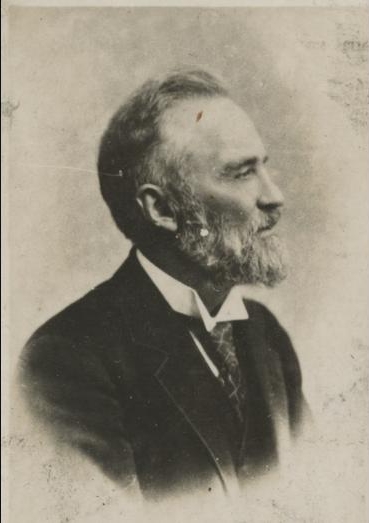
Unknown photographer
James W Sayer, c. 1905
black and white photograph
Courtesy of Norman Crossley
1914
In 1914, the Geelong Art Gallery Association lost another prominent member and advocator: James Whitley Sayer, the mastermind behind every event and exhibition thus far.
Horace Frank Richardson, former Mayor of Geelong, requested that a life-sized oil painting of Sayer be hung in Geelong Gallery to commemorate his legacy and his tremendous efforts in bringing about the construction of the permanent site—which he unfortunately did not live to see.
The foundation stone of the G M Hitchcock Memorial Art Gallery was laid in this year by the Honorable William Alexander Watt, Premier of Victoria. After 18 years of campaigning and fundraising, construction of Geelong Gallery finally commenced.
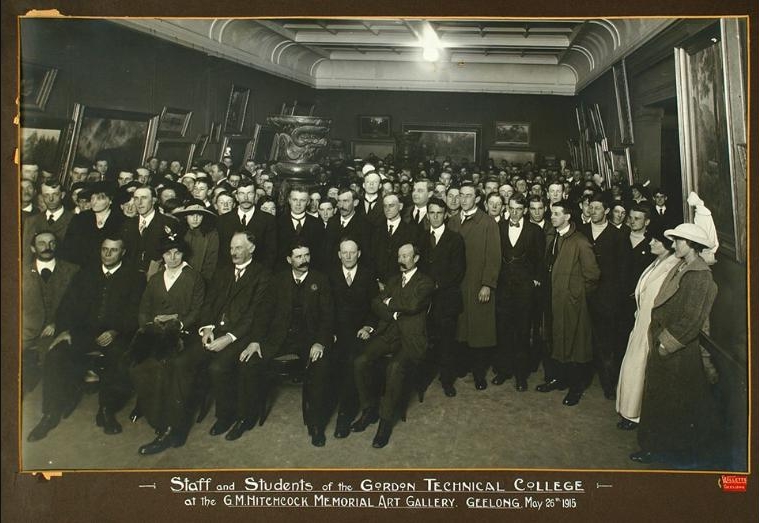
Unknown photographer
Staff and students of the Gordon Technical College at the GM Hitchcock Memorial Art Gallery, Geelong, May 26th 1915
black & white photograph
Geelong Gallery archives
1915
Although the foundation stone was laid in February 1914, it wasn’t until May 1915 that Geelong Gallery welcomed the public inside its doors.
The opening was a grand event, with Chief Secretary, the Hon. John Murray, officially opening the building. Between 300–400 Geelong Gallery subscribers attended the event, where they viewed works under electric lights and listened to the city band play in the Johnstone Park bandstand.
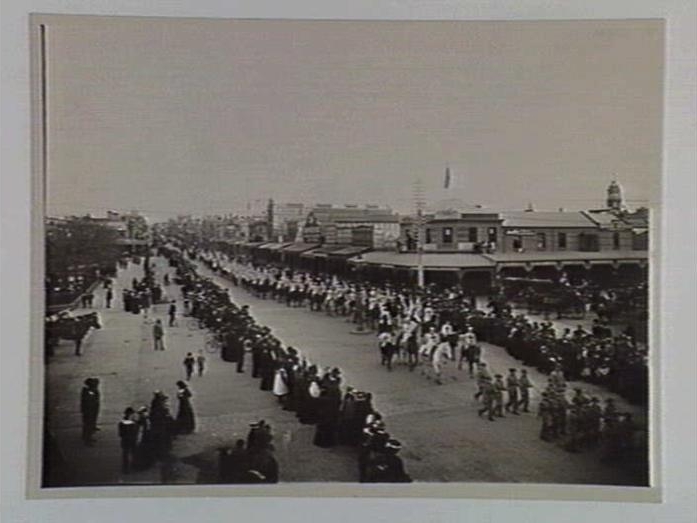
C Fox
The first Gala Day procession showing Moorabool Street, Geelong, 1916/1936
gelatin silver photograph
State Library Victoria
1916
In 1916, twenty years after establishment, the Geelong Art Gallery Association was finally settling into their new premises. It was a year focused on finding their feet and dealing with the challenges of maintaining their own space.
Geelong celebrated its first Gala Day in 1916, a colourful and spectacular festival originally created to raise money for the Red Cross Society. Although put on hold in 2020, Gala Day continues to raise funds for Barwon Health—University Hospital Geelong, and features plenty of sounds, colours, magic and performers parading down Geelong’s local streets.
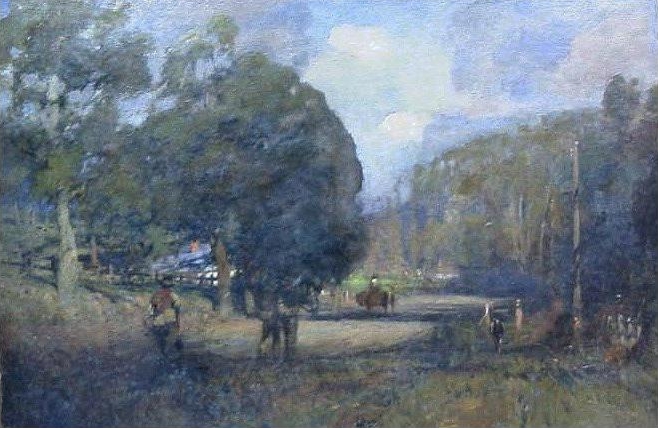
Walter Withers
The valley of the Lower Plenty, c. 1904–05
oil on canvas
Geelong Gallery
Gift of the John Traill family, 1917
1917
In 1917, Geelong Gallery exhibited a collection of paintings by the late British-Australian artist, Walter Withers, at the request of his wife, Fanny.
After the exhibition, Fanny contacted John Traill, a Geelong businessman, and requested that he buy Walter’s painting The valley of the Lower Plenty. Traill purchased the painting, and gifted it on behalf of his family to Geelong Gallery.
Old newspaper clippings from the Geelong Advertiser revealed that this work was to be acquired by the National Gallery of Victoria, but a regulation at the time meant only two works by an Australian artist could be purchased for the NGV by the Felton Trustees, a bequest by the late Alfred Felton that funded the acquisition of works for the organisation.
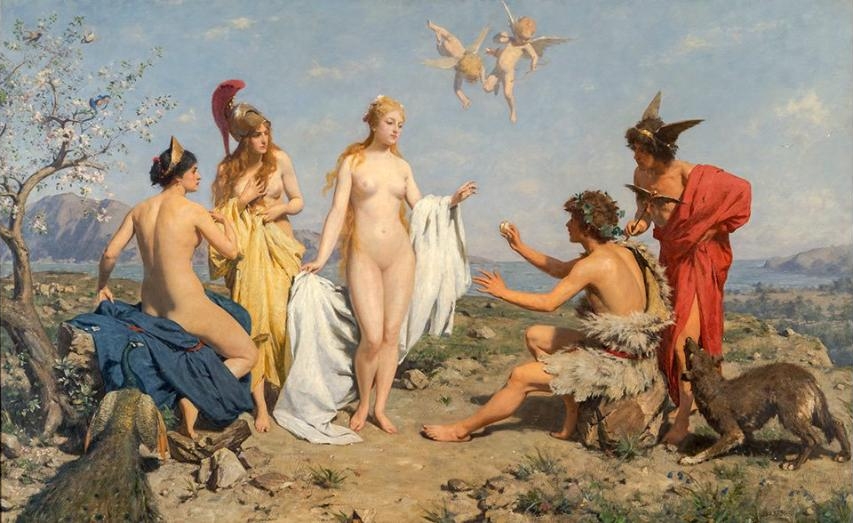
Johann Kraemer
The Judgement of Paris, 1888
oil on canvas
Geelong Gallery
Gift of the family of the late John Traill, 1918
1918
The Trojan War is one of the most recognisable events in Greek mythology, and has consistently inspired many classical works. The Judgement of Paris is said to be the catalyst of the Trojan War, after Paris of Troy was charged by Zeus to decide who was the fairest out of the goddesses Aphrodite, Athena and Hera.
This event has been interpreted by many artists, among them Johann Kraemer, whose work The Judgement of Paris was bequeathed to Geelong Gallery in 1918 by the family of the late John Traill.
Kraemer’s depiction centres on the scene in which Paris offers a golden apple to Aphrodite, while Hera and Athena look on. The primary colours of the figures’ drapery are contrasted with the earthly tones of the landscape, and the addition of winged putti and animals create a magnificent blend of myth and allegory.
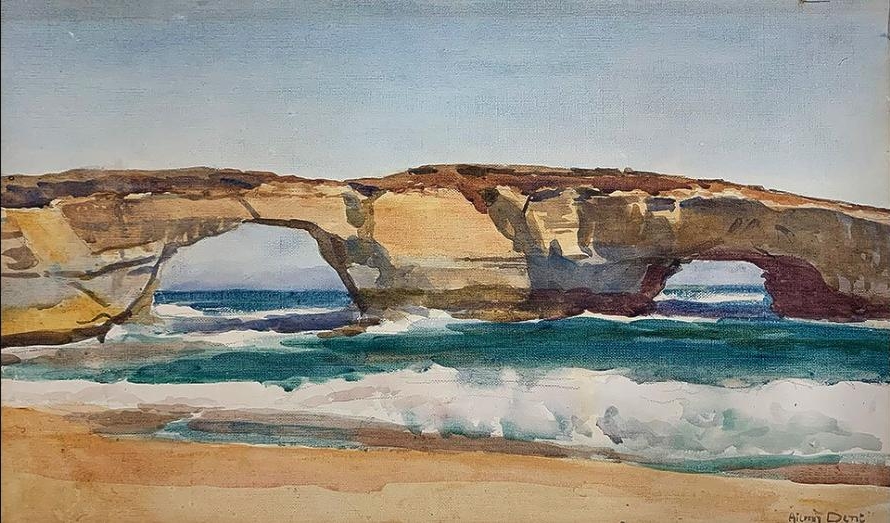
Aileen Dent
London Bridge, Port Campbell, c. 1920s
watercolour
Geelong Gallery
Gift of Howard Hitchcock, 1929
1919
The first stage of the Great Ocean Road began construction in 1919. The first stage was built as a war memorial for fallen World War I soldiers by approximately 3,000 returned servicemen.
In the 1920s, Australian artist Aileen Dent painted London Bridge, Port Campbell. Dent’s work depicts what is now known as London Arch in Port Campbell, capturing the landmark’s former structure before its partial collapse in 1990.
Dent’s use of blues, browns and yellows encapsulates our landscape’s natural colourings, and highlights the distinctive strata of limestone that defines many significant rock formations found along the coast of Victoria.
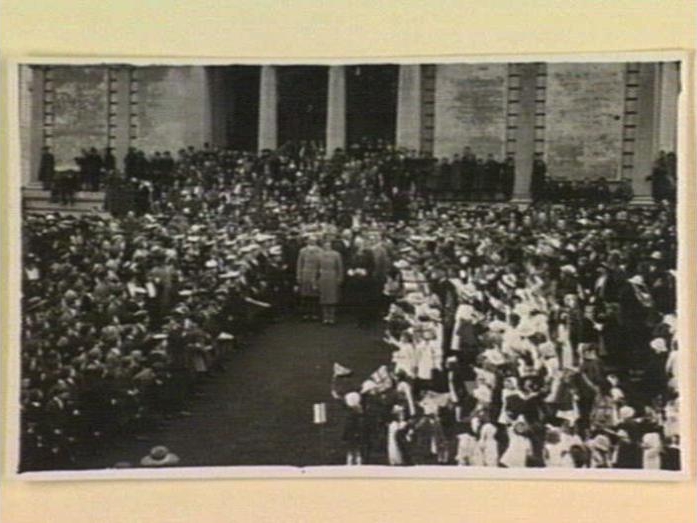
Unknown photographer
His Royal Highness The Prince of Wales visit to Geelong Vic. in June 1920. Schoolchildren singing “God Bless the Prince of Wales” Johnstone Park, c. 1914–41
black and white printed postcard
State Library Victoria
1920
Prince Edward VIII, Prince of Wales, visited Geelong in 1920. He toured around the country to extend thanks for Australia’s support during World War I, and to strengthen links to the British Empire.
His tour was popular, with droves of supporters seeing him around the country. His visit to Geelong saw Johnstone Park crowded to its limits. These two postcards show the Prince of Wales in front of the George Michelmore Hitchcock Memorial Art Gallery, as well as a view of the crowd from the Geelong Town Hall.
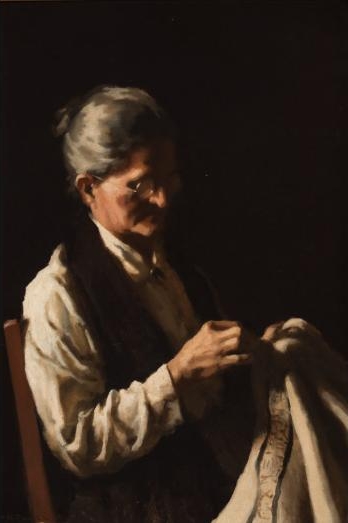
William Rowell
Auntie Bella, 1920–21
oil on canvas
Geelong Gallery
Purchased by public subscription, 1921
1921
William Rowell’s Auntie Bella was displayed in the Twenty Painters exhibition in Melbourne in 1921, and attracted much admiration by visitors, amongst them, Mayor Alderman Hitchcock. This work was so highly regarded that Mayor Hitchcock helped to acquire it for Geelong Gallery.
In addition to Hitchcock’s personal contribution, several Geelong Art Gallery Association members and supporters financially aided the purchase of the painting, holding a concert to raise additional funds.
The figure in the image is a woman called Arabella Stuart, born in 1859 at Saltwater River in Tasmania, growing up in Parkdale, Melbourne. For many years Stuart’s house was a common gathering place for artists, and it is thought that Rowell was one of these artists.
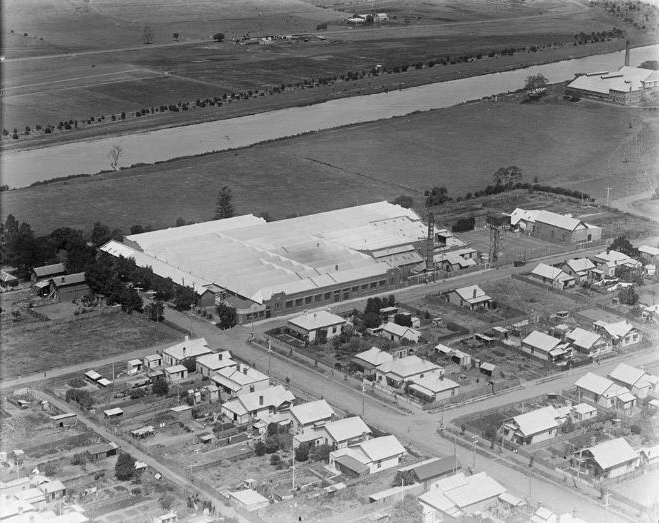
Charles Daniel Pratt
Geelong R.S.& S. Woollen & Worsted Co-op Manufacturing Co., mill on Barwon River, west side of Pakington Street, Chilwell, showing several stages of renovation, ca. 1927
black and white photograph
State Library Victoria
1922
In 1922, the Geelong Returned Soldiers and Servicemen (R.S and S) Woollen Mills was established to provide employment to returned servicemen from WWI.
Situated at the Newtown end of Pakington street, the mill specialised in materials such as worsted cloth and woollen tweed, using a wide range of artificial and natural fibres. Part of the mill is still dedicated to textile manufacturing, with Geelong Textiles taking over the operations in 1971.
Today, the R.S and S Woollen Mills operate as a creative hub, housing artists and creatives such as Boom Gallery, Cricket Ink Studios, Blink Dance Theatre, Natural Supply Co and No Frills Art.
Eugene Von Guerard
Aborigines met on the road to the diggings, 1854
oil on canvas
Geelong Gallery
Gift of W Max Bell and Norman Belcher, 1923
1923
1923 saw many important acquisitions for Geelong Gallery’s permanent collection.
Geelong Art Gallery Association Vice President, W Max Bell, and Geelong footballer and businessman, Norman Belcher, purchased two Eugene von Guérard works for the collection: Aborigines met on the road to the diggings and View from Fritz Wilhelmberg, Herne Hill, Geelong (Mr Levien’s hut on the Barwon).
Harold Septimus Power’s work A shell-swept road was gifted by Henry Percival and Enid Mary Douglass, adding a powerful depiction of war to the collection.
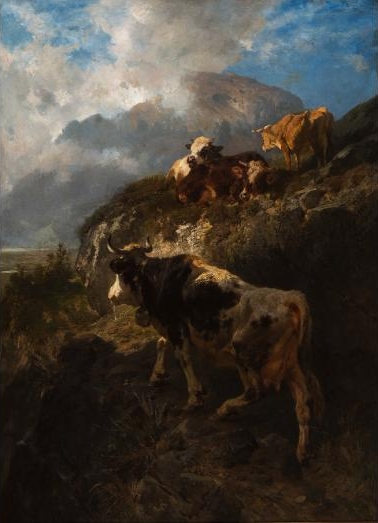
Towards the end of the year, subscribers voted to purchase Anton Braith’s work Hill cattle, which had been loaned to Geelong Gallery by Wilfred Austin prior.
Braith’s work is an exquisite depiction of cattle in a peaceful country setting. In contrast, Power’s work is an emotional and piercing representation of the realities of war and conflict.
Howard Brown (photographer)
Untitled (Hitchcock Gallery with an exhibition of Paul Montford’s sculpture), 1924
black & white photograph
Geelong Gallery archives
1924
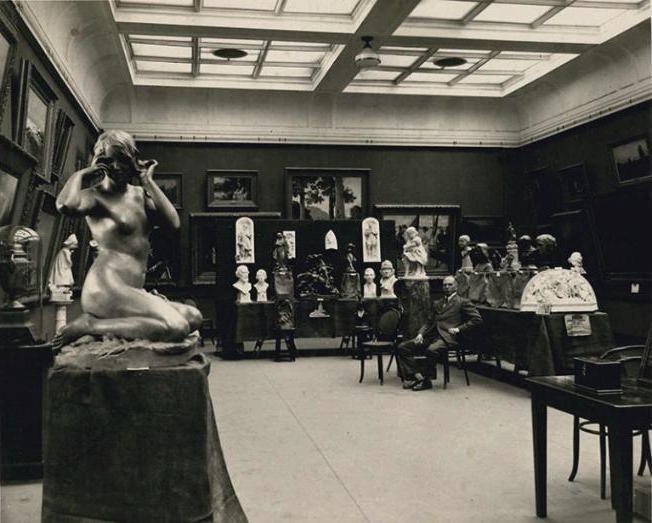
In mid-1924, Geelong Gallery exhibited Paul Montford’s collection of statues, the first exhibition of its kind in Geelong. The collection consisted of around 50 busts made of bronze and plaster.
Pictured is a photograph by Howard Brown of the Montford exhibition, with Montford himself seated in front of his collection inside the George Michelmore Hitchcock Memorial Art Gallery. To the left of the image is his sculpture Water Nymph, a beautifully made, life-size work depicting a nymph seemingly concealing herself from lookers on.
The image is filled with busts of people Montford has sculpted, including Geelong locals F Backsole (architect), and Miss Price (Gordon Institute of Technology).
Lockwood Studio photographer
T-model Ford car parked outside Geelong Library at its launch in 1915
negative photograph
Harold Paynting Collection, State Library Victoria
1925
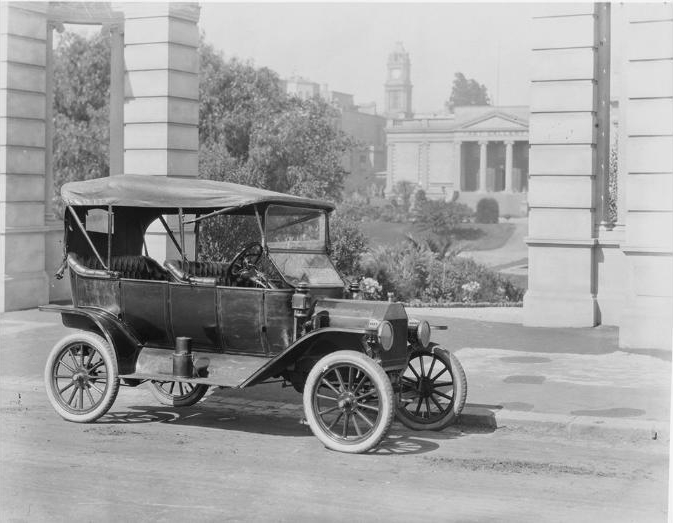
The Ford Motor Company arrived at its Geelong home in 1925. Providing significant employment opportunities, the Geelong factory stayed in operation until 2016, 91 years after its arrival.
Pictured is a Ford Model-T parked at Johnstone Park with the George Michelmore Hitchcock Memorial Art Gallery visible in the background.
This was photographed in 1915, the year of Geelong Gallery’s opening, yet the Model-T was not built in Geelong until 1925, so we can assume this particular vehicle was built outside of Geelong. The Model-T was the first vehicle built in the Geelong Ford factory, later switching to the Model-A in 1928.
Charles Wheeler
[Barwon River] 1921-22oil on canvas
Geelong Gallery
JH McPhillimy Bequest Fund, 1966
Courtesy of the artist’s estate
1926
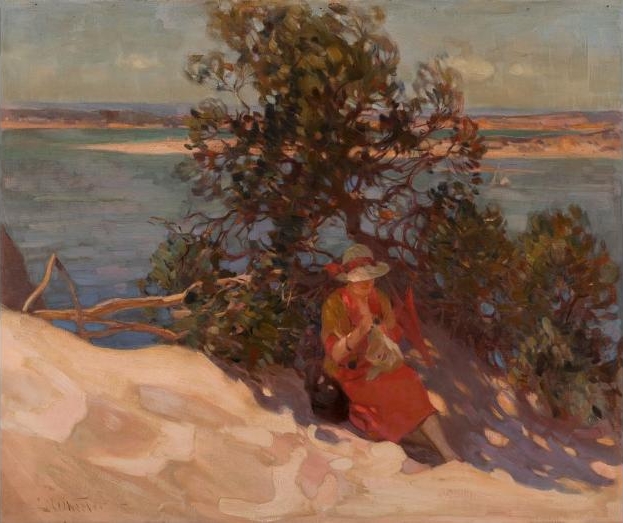
The Geelong and District Peace Memorial was officially opened in October 1926 by Lord Arthur Somers, Premier of Victoria at the time. Somers also opened the Barwon Bridge (Moorabool Street) in August of that same year.
The Memorial was built to commemorate soldiers who served in WWI, and continues to include the names of service men and women from every war fought since.
Australian artist Charles Wheeler’s painting Barwon River was presented to J.A Thear, Mayor of Geelong, to celebrate the opening of the Barwon Bridge.
Pieter Barranti & Antonio Canova
[Quarrel of cupids (after Canova)] 19th centurymarble sculpture
Geelong Gallery
Gift of Mrs HP Douglass, 1920
1927
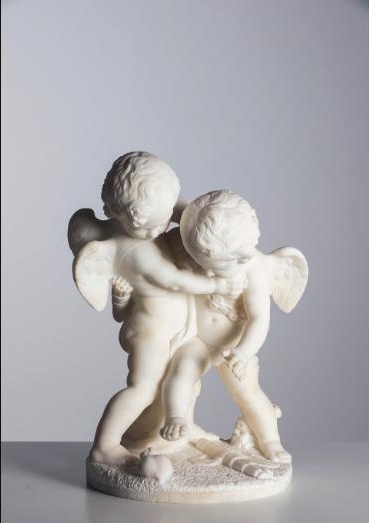
In 1927, Geelong Art Gallery Association former President and Vice-President Henry Percival Douglass passed away at the age of 68.
Douglass had a lasting impact on Geelong Gallery, so much so that members immediately campaigned to build a memorial wing in honour of him.
Pictured is a marble sculpture by Pieter Barranti and Antonio Canova, gifted to Geelong Gallery by Douglass’ wife Enid, who gifted several works to the collection.
Unknown photographer
[Untitled (Douglass Gallery interior)] c. 1940sblack & white photograph
Geelong Gallery archives
1928
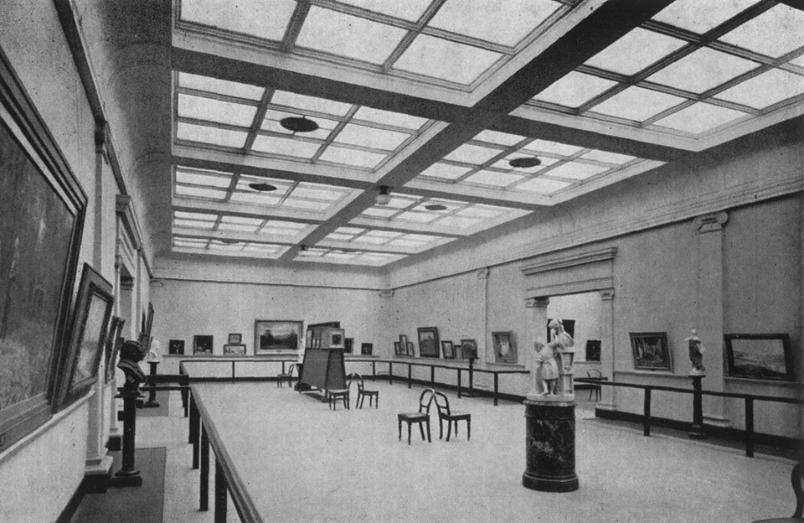
Geelong Gallery opened the Henry Percival Douglass Memorial Gallery in 1928.
The new space was an ideal setting to exhibit a larger selection of the permanent collection, which had quickly outgrown its previous location in the G M Hitchcock Memorial Art Gallery.
In 2021, the H P Douglass Memorial Gallery space was transformed for RONE in Geelong, a ground-breaking exhibition for Geelong Gallery.
Valeressos
[The petition] late 19th centuryoil on canvas
Geelong Gallery
Gift of James Wood, 1929
1929
In 1929, Geelong Gallery focused its energy on further organising the collection and managing the newly built H P Douglass Memorial Gallery.
Many donations were welcomed into the permanent collection, including several statues and an oil painting gifted by the late James Wood, a Melbourne citizen who grew up in Geelong.
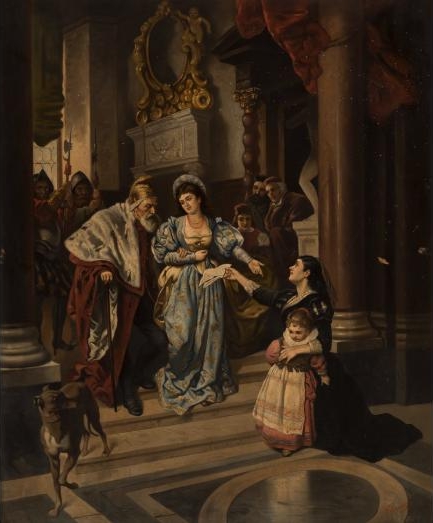
Amongst the works gifted by James Wood was The petition by Valeressos, a mysterious and mononymous artist of which little is known. The image depicts a woman guiding an older male figure, both dressed in richly coloured noble attire. The woman gestures to a kneeling female figure dressed in black attire, possibly signifying the recent death of a loved one. She holds a piece of paper in her outstretched right hand—likely the petition referred to in the work’s title—and guards a child, who warily regards the dog in the composition’s lower left, with her left arm.
James Northfield
[Geelong, Victoria, Australia] c. 1930sposter print
Geelong Gallery
Purchased through donations, 2009
© James Northfield Heritage Art Trust
1930
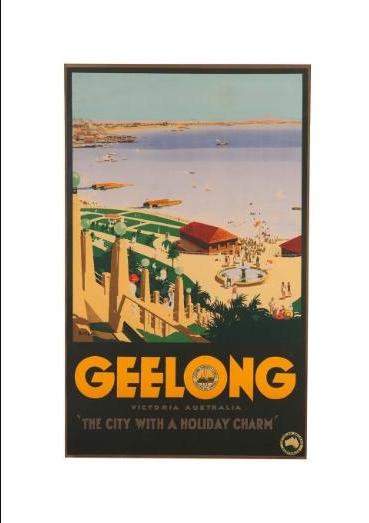
The Victorian Railways travel poster campaign saw Geelong-born artist James Northfield engaged to create some key works throughout the 1920s and 1930s to promote railway visitation to the area.
Northfield’s Geelong, Victoria, Australia depicts an early scene from Geelong’s iconic waterfront, looking down on the water fountain, steps and beach house.
Adolph Braun & Co
[Portrait of the artist (after A van Dyke)] c. 1880sautotype
Geelong Gallery
Gift of Mrs AW Marwood, 1931
1931
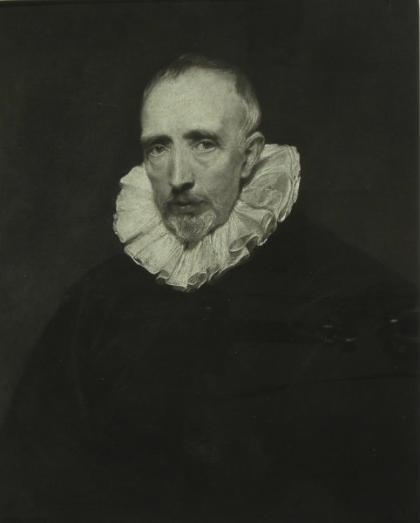
In 1931, five intriguing Adolph Braun and Co photographic works joined the permanent collection.
These black and white portraits were gifted to Geelong Gallery by Mrs A W Marwood, a Geelong resident and honorary life member of Geelong Gallery.
Adolph Braun was an important figure in the burgeoning photographic scene of the 19th century, and became well known for his reproductions of old master portraits.
Created using a carbon print process, works of this documentary nature were known in the 19th century as autotypes, or true representations of the original. In these two examples, Braun has recorded two works in the collection of the National Gallery, London by two famed portraitists of the 17th century: Anthony van Dyck and Rembrandt van Rijn.
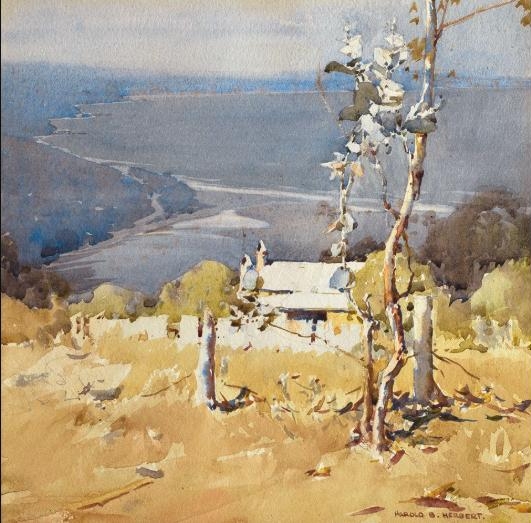
Harold Herbert
[Sunlight gleam, Lorne] c. 1930swatercolour
Geelong Gallery
Gift of Heather McKellar, 2004
1932
In 1932 the last stage of the Great Ocean Road was built, which connected Lorne and Apollo Bay, completing the famous stretch.
Well-known Geelong businessman and former Mayor, Howard Hitchcock, started the Great Ocean Road Trust in 1918 to fund the road’s construction, although unfortunately he passed away just months before its completion.
Thirteen years after construction began in 1919, the completed Great Ocean Road finally welcomed its first travellers. Harold Herbert’s Sunlight gleam, Lorne offers a rare glimpse into the area in the 1930s. While the road itself is not visible in the work, it can be speculated that Herbert used the road to reach a vantage point to capture this work.
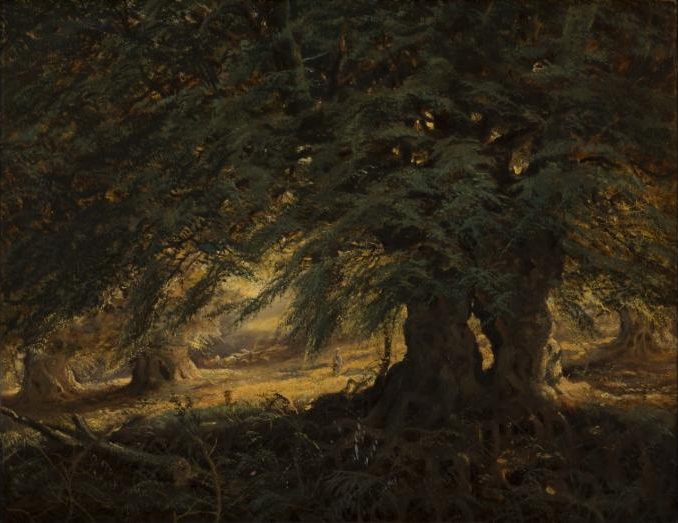
Unknown artist
[Burnham Beeches] 19th centuryoil on canvas
Geelong Gallery
Purchased with the assistance of the HP Douglass Bequest Fund, 1933
1933
In 1933, Geelong Gallery acquired Burnham Beeches by an unknown artist, but it theorised the artist could be English artists, David Cox or Jas Townshend. This image takes its name from Burnham Beeches, an ancient forest in Buckinghamshire, England. The forest historically spanned almost the entire Buckinghamshire area, roughly the same size as Queensland.
Burnham Beeches, an art deco mansion in Sherbrooke, near Melbourne, was named after the English forest, and was the site for Rone’s 2019 Empire Project.
This image is a highly technical and detailed depiction of the sun illuminating a small forest glade. A solitary figure appears in the midst of this sublime natural setting, dwarfed by the giant gnarled trunks and dense canopy of the trees that encircle them. Although the creator of this work remains unknown, in 1901 Geelong Advertiser noted that ‘it is easy to see that the work is the handiwork of a master, and everything is true to nature’.
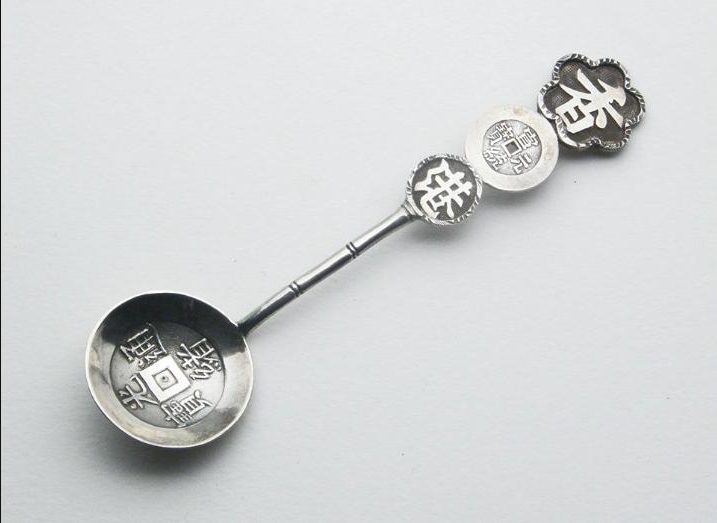
WH
[Good luck’ spoon] c. 1920silver metalwork
Geelong Gallery
Bequest of Mrs Howard Hitchcock, 1934.
1934
In 1934, the Trustees of the late Charlotte Louisa Turnbull Hitchcock’s (née Royce, Mayor Howard Hitchcock’s wife) estate, presented Geelong Gallery with a number of collectable spoons.
Also known as Louie, Hitchcock collected these spoons from all over the world, including places such as Switzerland, Sweden, Egypt, Gibraltar, and Sri Lanka.
Altogether, the collection consists of roughly 130 spoons. Pictured is just a small handful of these items. The craftsmanship on these spoons is inventive and impressive.
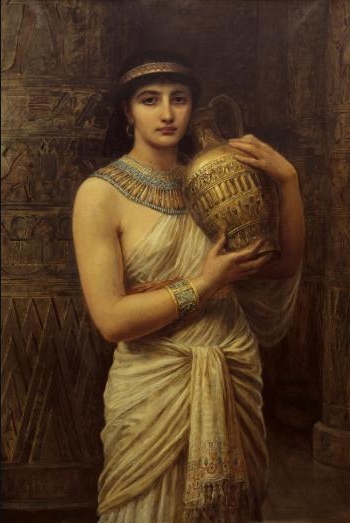
Edwin Long
[The Babylonian maid] 1883oil on canvas
Geelong Gallery
Gift of JH McPhillimy, 1935.
1935
James Hugh McPhillimy and his sister Louisa Jane McPhillimy presented Geelong Gallery with five new works for the permanent collection in 1935.
They gave Edwin Long’s The Babylonian maid and Henry Davis’ A placid morning on the Wye as a Centenary of Melbourne gift. In October, they made a further gift of On the Thames, by Benjamin Leader and An Eastern well by Frederick Goodall.
In December 1935, Louisa gifted Thomas Faed’s Reading the Bible, which depicts a working class family in a small cottage. A young boy is reading the Bible, as the other children roam around the home, while the three adults sit and listen to the verses.
Reading the Bible was among the first 50 paintings that Thomas Faed exhibited at the Royal Scottish Academy in Edinburgh. According to Faed himself, this work was: ‘the first I sold, and right proud I was’.
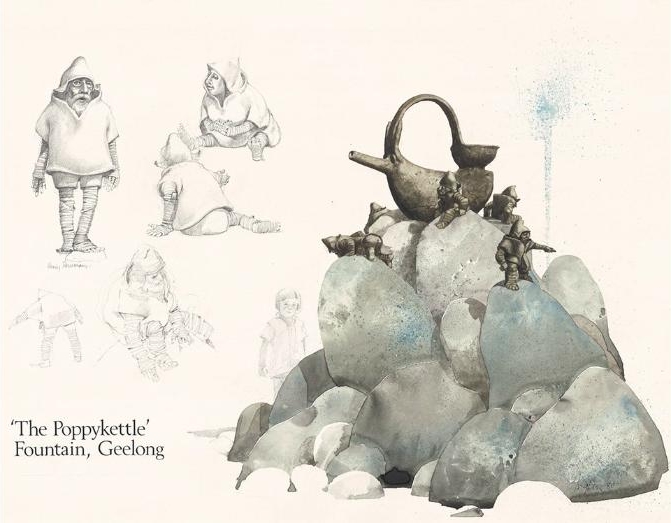
Robert Ingpen
[The Poppykettle Fountain, Geelong] 1980watercolour
Geelong Gallery
Bequest of Dorothy McAlister, 1987
1936
According to records, in 1936 Geelong Gallery became the first regional art gallery to appoint a Director, with A. E. Anderson assuming the position.
1936 was also the year Geelong illustrator Robert Ingpen was born. Robert is most well known for his Poppykettle series: a tale about a group of Peruvian gnomes, who travel from Peru to Geelong in a sea-faring kettle inspired by Incan pottery.
The Poppy Kettle Fountain, a local landmark celebrating the series, was designed by Ingpen and its remnants were gifted to the city by Dorothy McAlister in 1996. Originally installed at Fairnie Park, the small statuettes were then relocated to their current location at the children’s playground next to Cunningham Pier.
The 2018 exhibition Reimagine featured Ingpen’s work The magic bookcase, an almost seven metre long set of wooden panels depicting iconic children’s story characters like Alice, Humpty Dumpty, Peter Pan, Captain Hook and the Toad of Toad Hall from Wind in the Willows.
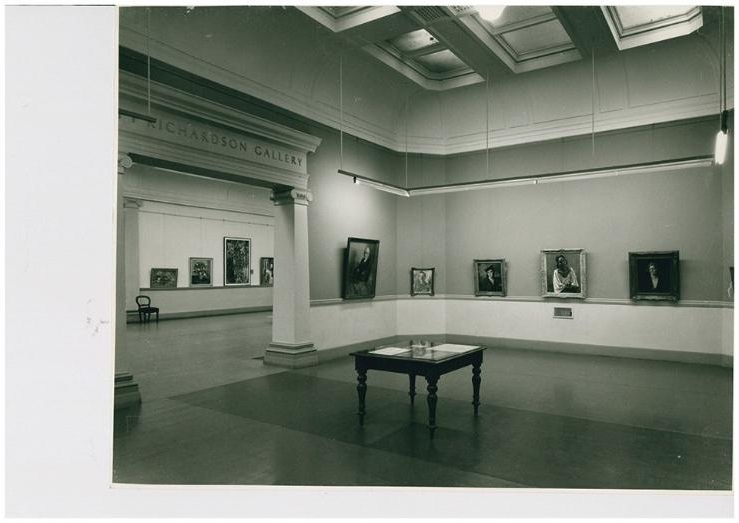
HF Richardson Gallery
installation view (with works by James Quinn, Reginald G Eves, William Dargie, Colin Colahan, John Longstaff) c. 1964-65
1937
The H F Richardson Memorial Gallery was officially opened on 14 April 1937. The Gallery’s namesake, Horace Frank Richardson, was a local businessman and politician who served as Mayor of Geelong when the Geelong Art Gallery Association was established.
Richardson is partly to thank for Geelong Gallery’s establishment, as he approved the Geelong Art Gallery Association’s creation and supported Geelong Gallery’s efforts over the years. Richardson passed away in 1935 at his home ‘Kardinia’.
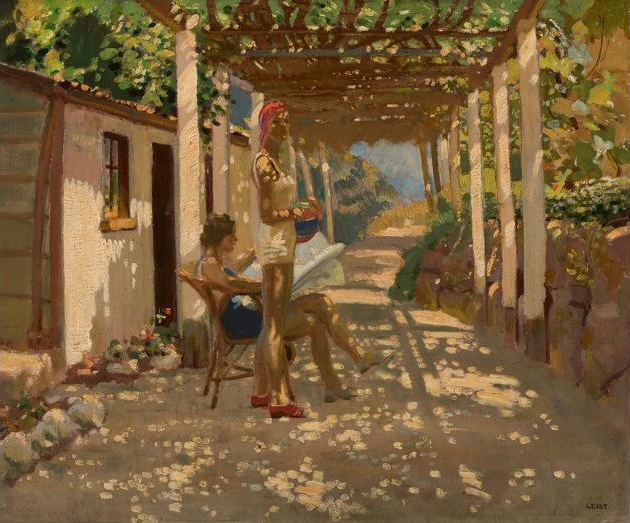
Fred Leist
[Pergola] 1930oil on canvas
Geelong Gallery
The Geelong Centenary art prize, 1938
1938
In 1938, the James Hugh McPhillimy Gallery was opened by then-Prime Minister Joseph Lyons, and was named after James Hugh McPhillimy, an avid Geelong Gallery supporter whose personal donation underpinned the successful construction of the new wing.
The establishment of the J H McPhillimy Gallery shifted Geelong Gallery’s main entrance from Johnstone Park to its current location on Little Malop street.
1938 also marked Geelong’s centenary, with the city of Geelong being established in 1838. The 1938 Geelong Centenary Art Competition celebrated the occasion.
The winner of this competition was Australian artist Fred Leist, for his work Pergola. Leist was an accomplished landscape and portraitist who learnt plein air painting techniques whilst studying under Julian Ashton in Sydney in the 1890s. Here Leist’s skilful rendering of dappled light and shade is in full effect as he captures two stylishly-clad women escaping the heat of the day.
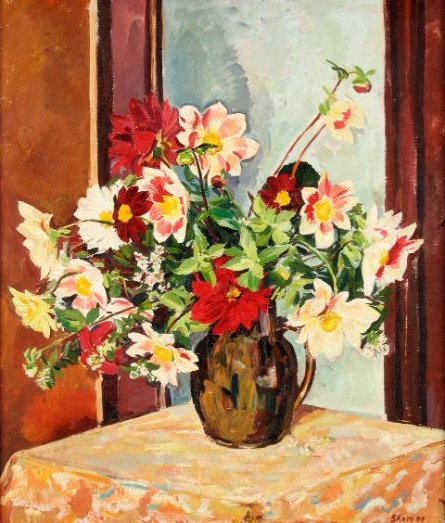
Arnold Shore
[Dahlias] 1939oil on canvas
Geelong Gallery
JH McPhillimy prize, 1939
1939
By 1939, Geelong was a bustling regional city and the Eastern Beach promenade and children’s pool were opened to the public.
Also in this year, Geelong Gallery held two art prizes, the Frank Evan Richardson Prize and the James Hugh McPhillimy Prize. The J H McPhillimy Prize was for oil paintings, watercolours and statuary, and was awarded in the inaugural year to Arnold Shore for his oil work Dahlias. The F E Richardson Prize was for any other medium, and was won by Murray Griffin for his linocut Spoonbill.
These works reflect the growing importance of the still life genre and works on paper to the collection: two artistic mediums that Geelong Gallery continues to advance and promote through the Geelong contemporary art prize and Geelong acquisitive print award.
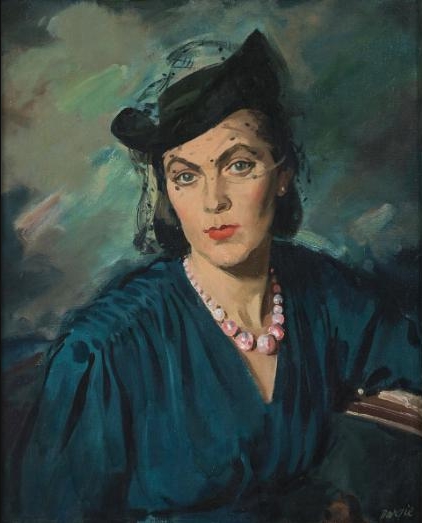
William Dargie
[Portrait of the artist’s wife] 1940oil on canvas
Geelong Gallery
JH McPhillimy prize, 1940
© Roger Dargie
1940
In 1940, long-time Geelong Gallery supporter James Hugh McPhillimy died, the namesake of our J H McPhillimy Gallery.
This year, the J H McPhillimy prize focused on oil painting and the F E Richardson prize recognised outstanding achievement in watercolours.
The two works that took the crowns this year, like the previous year, were starkly different, yet possess impressive levels of skill and beauty.
The winner of the J H McPhillimy prize was Australian artist William Dargie, for his work Portrait of the artist’s wife. John Loxton won the F E Richardson prize for his work Evening gleam, Woodend.
William Dargie was renowned for his portrait painting, winning the Archibald Prize eight times.
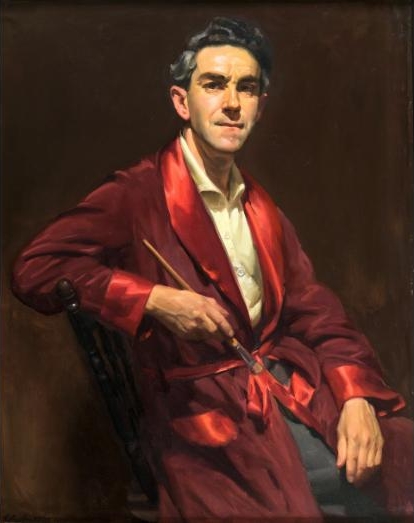
Ernest Buckmaster
[Self portrait] 1940oil on canvas
Geelong Gallery, Purchased 1941.
1941
In 1941, Geelong Gallery purchased an intriguing and introspective work by a famous Victorian artist.
With its palette of deep reds and expert rendering of a dressing gown’s smooth silk trims, Self portrait is a striking and self-assured depiction of its subject and creator, Australian artist Ernest Buckmaster.
Buckmaster was born in Hawthorn, Melbourne, in 1897, and worked as a war artist during World War II. An acclaimed portraitist, he won the Archibald Prize in 1932 for his likeness of lieutenant-governor of Victoria, Sir William Irvine.
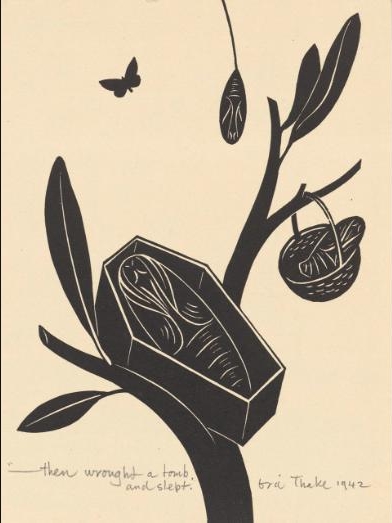
Eric Thake
[Then wrought a tomb, and slept] 1942linocut
Geelong Gallery
Purchased with funds generously provided by the Friends of the Geelong Gallery and the Gallery Grasshoppers, 1986.
1942
In 1942, Eric Thake created his work Then wrought a tomb, and slept, a linocut that demonstrates his pared back, contemporary style. This work is a part of a series of greeting cards created by Thake during World War II.
In 1941, Thake had begun making these Christmas cards, partly to make money, partly to boost morale. By 1948, the Christmas cards had developed a following and other artists began sending him greeting cards in the hope of receiving one of his works in return.
Geelong Gallery purchased this work in 1986 with thanks to funds provided by the Friends of the Geelong Gallery and the Gallery Grasshoppers.
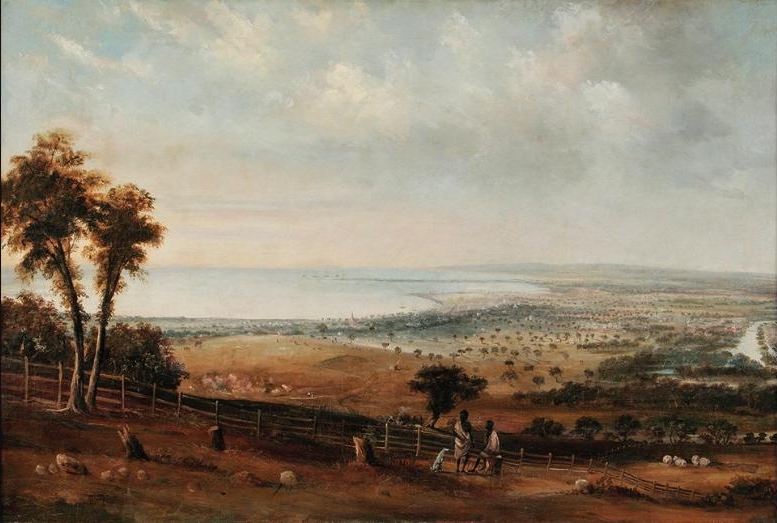
William Duke
[Geelong from Mr Hiatt’s, Barrabool Hills] 1851oil on canvas
Geelong Gallery
Gift of the family of Edward John Bechervaise, in his memory, 1943.
1943
In 1943, Geelong Gallery decided to postpone events such as the annual art competitions until after World War II.
To support the war effort, Geelong artist Lois Hyett held an exhibition and sale of her watercolours in the Douglass Gallery, with the proceeds donated to the Prisoners of War Fund. This was a significant event in Geelong Gallery’s history, as this was the first exhibition by a Geelong artist held in the space.
Although Geelong Gallery did not acquire any of Lois’ works, they did acquire another work of local significance in the same year: Geelong from Mr Hiatt’s, Barrabool Hills by William Duke. This important example of colonial landscape painting depicts the town of Geelong and Corio Bay from the Barrabool Hills, showing a tall unidentified landmark in the distance and the Barwon River on the right. Two First Nations People stand in the foreground, as if surveying the changes brought to bear on the land.
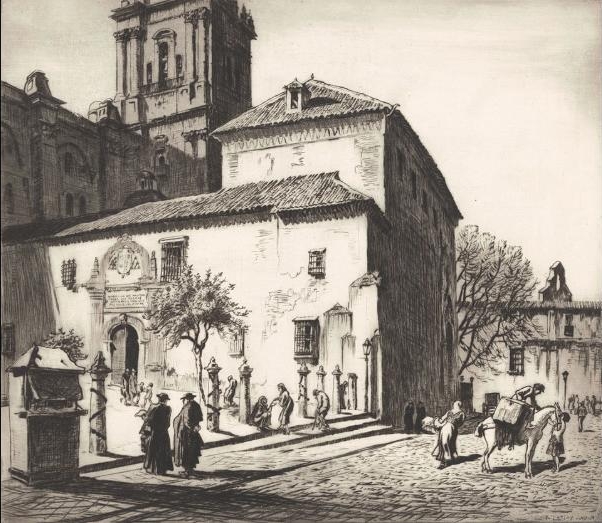
Lionel Lindsay
[The Sagrario, Malaga] 1937drypoint and etching
Geelong Gallery
Purchased 1944
Courtesy of the National Library of Australia, Canberra
1944
In 1944, Geelong Gallery welcomed a large number of prints by Australian artist, Lionel Lindsay, into the collection. Overall, 105 works were acquired through purchase and gift by Lindsay himself: an impressive influx of work by one of Australia’s most significant printmakers in a single year.
Lindsay’s extensive travels across Italy and Spain are documented throughout these wood engravings, etchings, engravings and drypoints, which depict the architecture, streetscapes and everyday life in Southern Europe during the early twentieth century.
Lindsay was particularly interested in churches and the way these structures belonged to the social fabric of the towns and cities he visited. The Sagrario, Malaga depicts the Iglesia de Santa María del Sagrario, an iconic Elizabethan Gothic church in Málaga, Spain, and the wide variety of residents who convened in its surrounds.
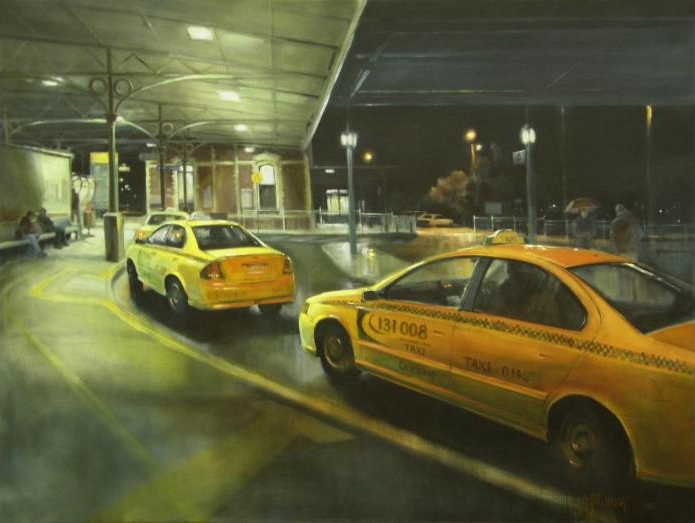
Susan Sutton
[Winter. Waiting for the 8.27, Geelong Railway Station] 2008oil on canvas
Geelong Gallery
Gift of the artist, 2008.
1945
By the end of WWII in 1945, the position of Honorary Secretary of the Geelong Art Gallery Association remained vacant. The position was soon filled in 1946 by local businessman Alan David who was later also appointed to the role of Honorary Treasurer.
David was a Major in the Australian Army and an accountant and company auditor by trade. He volunteered at Geelong Gallery for 30 years, retiring in 1975. David was also a key figure in the Victorian Public Galleries Group (VPGG), and worked hard to raise the profile of regional art galleries in the state.
David passed away in 2005 but his legacy lives on both in and out of Geelong Gallery. David’s daughter, Susan Sutton, is a regional artist, whose oil paintings depict the coastal culture of the Great Ocean Road. Her work Winter. Waiting for the 8.27, Geelong Railway Station joined the Geelong Gallery’s permanent collection in 2008.
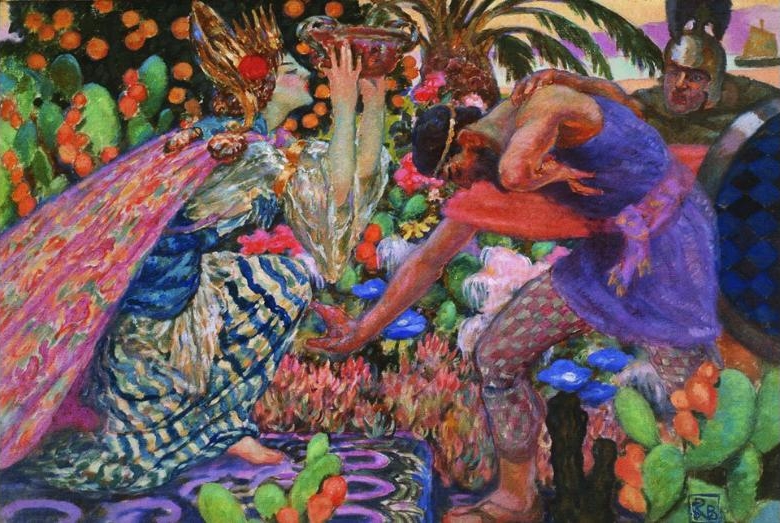
Rupert Bunny
[Circe and Ulysses] 1919oil on canvas
Geelong Gallery
Purchased 1946
1946
In 1946, Geelong Gallery held an exhibition of arts and crafts works by the students of ten Geelong secondary schools. The exhibition was so popular that after deliberation with the secondary schools, the event was decided to be made a bi-annual arrangement.
The exhibition was opened by businessman and designer Richard (Jimmy) Haughton James, who was said to be ‘staggered’ by the quality of the students’ works. As a gift for their participation, the schools were awarded a copy of Smike to Bulldog: letters from Sir Arthur Streeton to Tom Roberts, a delightful collection of letters exchanged between Australian artists Arthur Streeton and Tom Roberts.
Geelong Gallery also acquired new works throughout the year, including three works by the prominent Australian painter Rupert Bunny. The pictured work Circe and Ulysses depicts the Ancient Greek myth of the same name, which tells the story of the king Ulysses and his men who visited Aeaea, the island of the sorceress Circe.
Circe used potions and incantations to transform Ulysses’ crew into swine, but was later compelled by him to change them back to human form.
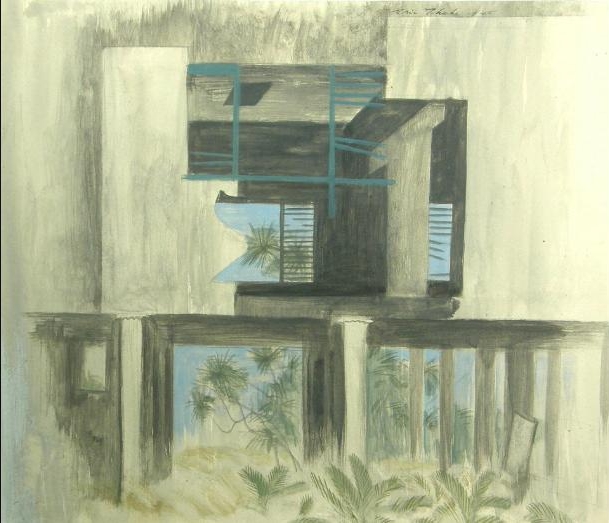
Eric Thake
[Looted house, Darwin] 1945watercolour
Geelong Gallery
FE Richardson prize, 1947
1947
In 1947, Geelong Gallery welcomed many new additions to the permanent collection as well as popular works on loan from other galleries.
One of the loaned works was St. Francis by Jusepe de Ribera, a famed 17th century Spanish painter, whose works are known for their striking interplay of shadow and light. According to our 1947 annual report, this work’s historical nature made it a favourite among locals.
The F E Richardson Prize for watercolour returned in this year, and the prize went to Australian artist Eric Thake for his work Looted house, Darwin.
Also in this year, the J H McPhillimy Prize for oils was reinstated after being delayed for a few years after the war. The winner of the prize was Australian artist Harley C Griffiths for his work The studio.
The studio depicts a woman seated in the controlled light of an art studio. This work highlights the often solitary and intimate act of painting, with Griffiths acting as a rare observer of an artist poised to make her first mark upon a fresh canvas.
Capt. Frank Hurley
[Sunken garden] c. 1940photograph
Geelong Heritage Centre
1948
In 1948, Geelong Gallery held the J H McPhillimy and F E Richardson Prizes again, and this year was the first time a female artist won one of the prizes.
Australian artist Nornie Gude was awarded the F E Richardson Prize for her watercolour work The red gate. Swiss-born Australian artist Sali Herman received the J H McPhillimy prize for his work Dan’s place.
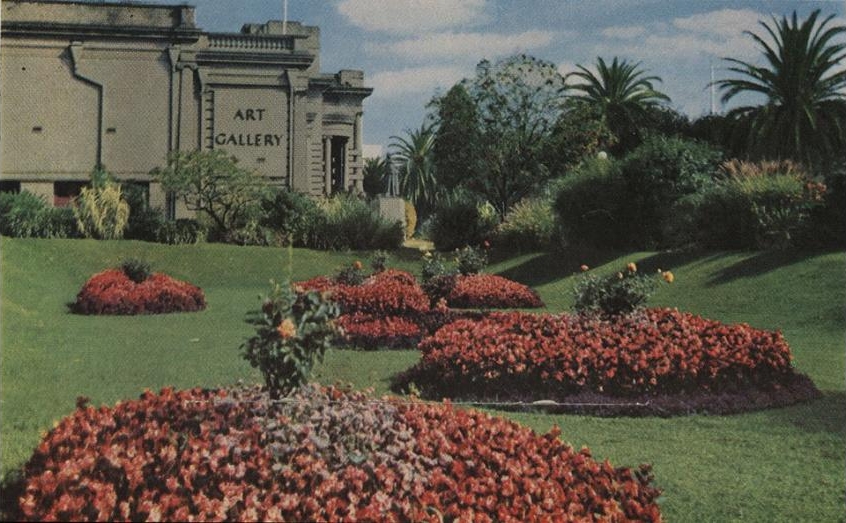
The renaissance style lettering spelling ‘Art Gallery’ on the left side of Geelong Gallery looking from Johnstone Park was also added in this year to help visitors find Geelong Gallery from the park.
Among the works added to the permanent collection was Nymphs worshipping a herm, bequeathed by the late Miss E B Batten.
At the time of this work’s acquisition, this painting was believed to be a work by Italian Baroque painter Salvator Rosa, and was originally titled Nymphs worshipping Satyr.
After careful inspection of the work’s stylistic and technical qualities, it was speculated that it was in fact created after Rosa’s lifetime – a theory that was confirmed after the work underwent conservation in 2004. The Prussian blue used in the nymph’s attire was not created until 1704, and Rosa passed away in 1673, thus making the true artist of the work unknown.
Mary E McLeish
[Spring holidays] (1947-48)oil on canvas
Geelong Gallery
JH McPhillimy prize, 1949
Purchased with funds generously provided by the Friends of the Geelong Gallery, 1981.
1949
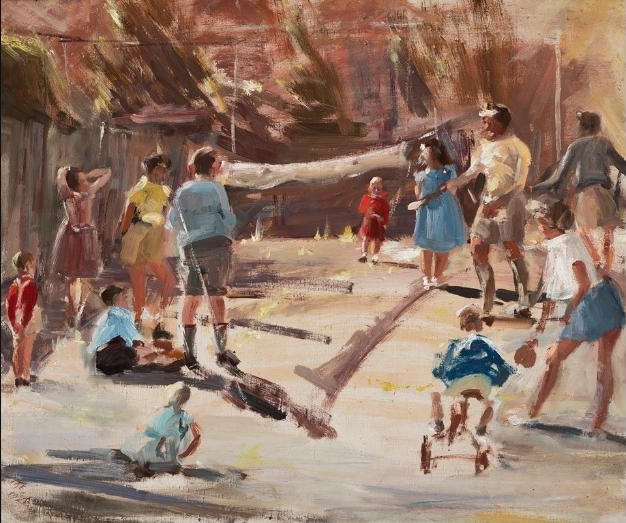
Once again the J H McPhillimy and F E Richardson Prizes were held, which, in 1949, attracted 102 entrants.
Mary E McLeish received the J H McPhillimy Prize for her oil painting Spring holidays, while Margaret Gunnersen was awarded the the F E Richardson Prize for her watercolour Sand dunes.
Geelong Gallery added three new works to the permanent collection throughout the year: Tasmanian landscape by Daryl Lindsay, Sydney Harbour from Bay Coast by Benjamin Edwin Minns, and Carmen by Colin Colahan.
Carmen depicts Carmen Mankey, an actor from the West Indies region. This work is a late example of the tonal realist style, an artistic movement that emerged in Melbourne during the 1910s which placed importance on tonal values to generate pictorial space and depth. Here, Colahan has used wide, rapidly applied brushstrokes in contrasting hues to capture the gathered and draped fabric of Carmen’s blouse.
William Frater
[Landscape, Alice Springs] 1949-50oil on composition board
Geelong Gallery
JH McPhillimy prize, 1950
1950
In 1950 Geelong Gallery celebrated its jubilee, commemorating 50 years since our first exhibition opened at Geelong Town Hall in 1900.
Geelong Gallery enlisted the help of records keeper, Edith Gurr, who undertook extensive research to author an historical publication titled Jubilee History that highlighted Geelong Gallery’s development over the last 50 years.
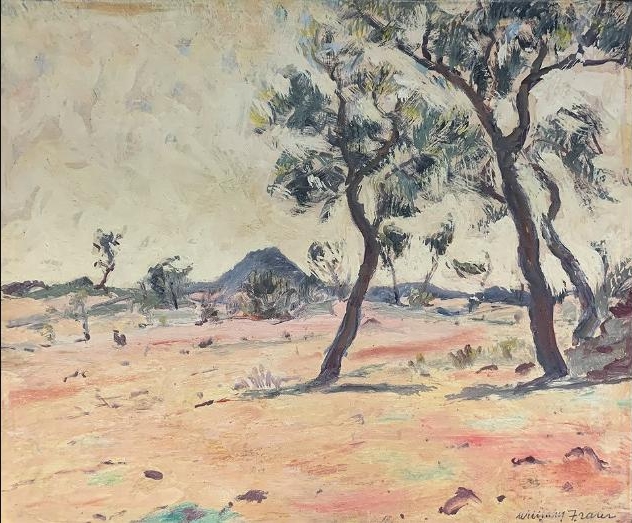
Landscape, Alice Springs by William Frater won the 1950 J H McPhillimy Prize, and was acquired for the permanent collection alongside Edinburgh from Arthur’s Seat by John D Moore and the F E Richardson Prize winning work Landscape with horseman by Ian Armstrong.
Frater’s work captures the natural colours and textures of the desert landscapes surrounding Alice Springs. In 1951 he exhibited the series to which this work belongs at Stanley Coe Gallery in Melbourne, where his work was met with great acclaim: an ‘Age’ critic praising his capacity to harness the ‘spirit or essence of an elemental landscape’ and the way his brushstrokes swept light into ‘a glowing orchestration of colour’.
Charles Bush
[Snow near Hampton Court, England] 1950painting
Geelong Gallery
JH McPhillimy prize, 1951
1951
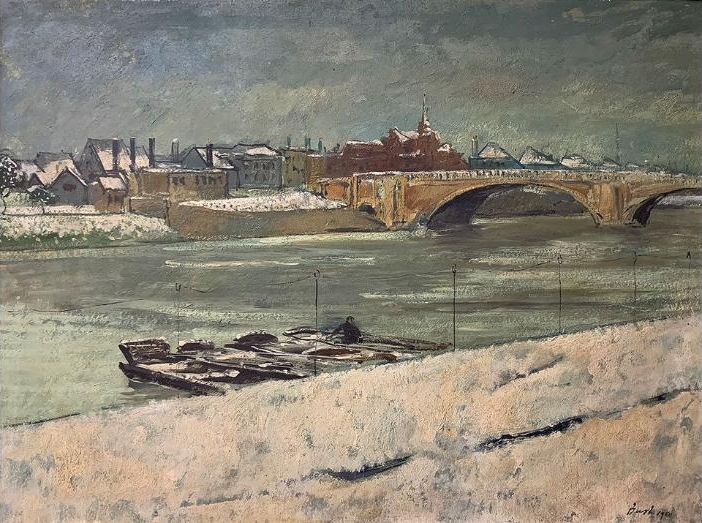
In 1951, Nornie Gude once again won the F E Richardson prize for watercolour with her work Flower piece, with Charles Bush winning the J H McPhillimy prize for oil painting with his work Snow near Hampton Court, England.
Instead of holding educational lectures in this year, Geelong Gallery held a musical event, with the Geelong Symphony Orchestra and the Geelong Madrigal Choir performing inside the H P Douglass Gallery.
They performed Dido and Aeneas, an opera by the English Baroque composer Henry Purcell, for a crowd of 400 people into the space. Locals Peggy Knibbs and Harold Strickland played the roles of Dido and Aeneas, while George Logie-Smith conducted the orchestra.
Later in this year, George and the GSO performed once again inside the Douglass Gallery, this time playing a selection of classical pieces by Giovanni Battista Pergolesi, Béla Bartók and Joseph Haydn, amongst others.
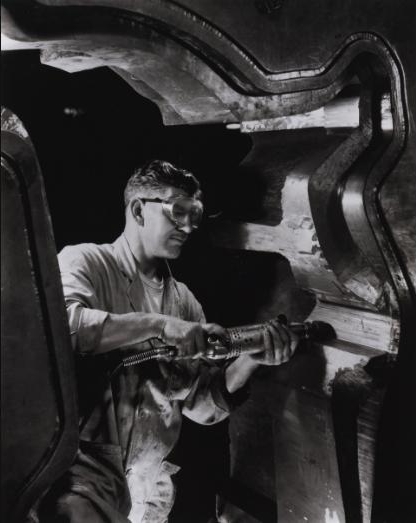
Wolfgang Sievers
[Grinding door pattern, Ford Motor Company, Geelong, Victoria] 1952/2001silver gelatin photograph
Geelong Gallery
Sybil Craig Bequest Fund, 2019
1952
In 1952, the annual J H McPhillimy and F E Richardson prizes were deferred so Geelong Gallery could focus their attention on the bi-annual Exhibition of Arts and Crafts by the Secondary Schools of Geelong and District.
Geelong Gallery only held one other exhibition in 1952, a collection of twenty Australian paintings loaned by the National gallery of Victoria. Instead of rearranging the existing works on the walls, the loaned works were hung on folding screens installed in the H P Douglass Gallery.
The Geelong Symphony Orchestra and Madrigal Choir returned for a performance surrounded by the Australian works, creating an immersive atmosphere for the guests.
1952 was also the year that Wolfgang Sievers photographed Grinding door pattern, Ford Motor Company, Geelong, Victoria inside the Ford Motor Company in Corio.
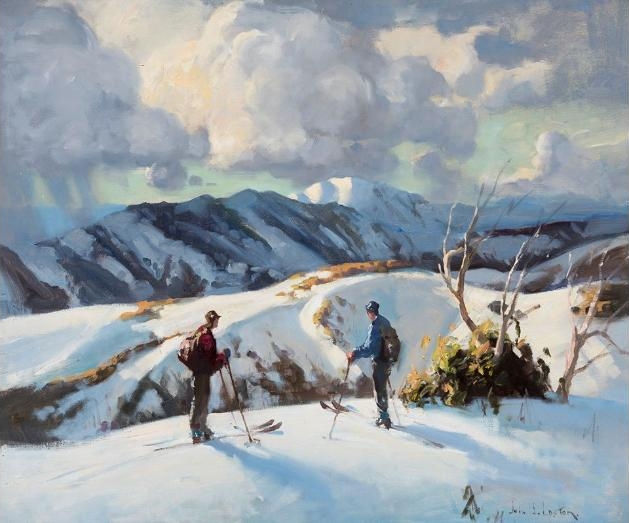
John Loxton
[Mt Feathertop from Hotham] (1930-49)oil on canvas
Geelong Gallery
JH McPhillimy Bequest Fund, 1953
Purchased with funds generously provided by the Friends of the Geelong Gallery, 1981.
1953
During 1953, Geelong Gallery held their focus on internal growth and community engagement. They experimented with the idea of an Exhibition of Contemporary Design, aiming to demonstrate to primary school students how practical and cheap everyday objects could be combined and arranged in an artistic manner aiding their development in creative thinking.
Only one work was acquired for the permanent collection this year, John Loxton’s Mt Feathertop from Hotham, which was purchased through the J H McPhillimy Bequest Fund.
A building fund was opened to raise money for the Max Bell Gallery, with £2000 being raised by the end of the year.
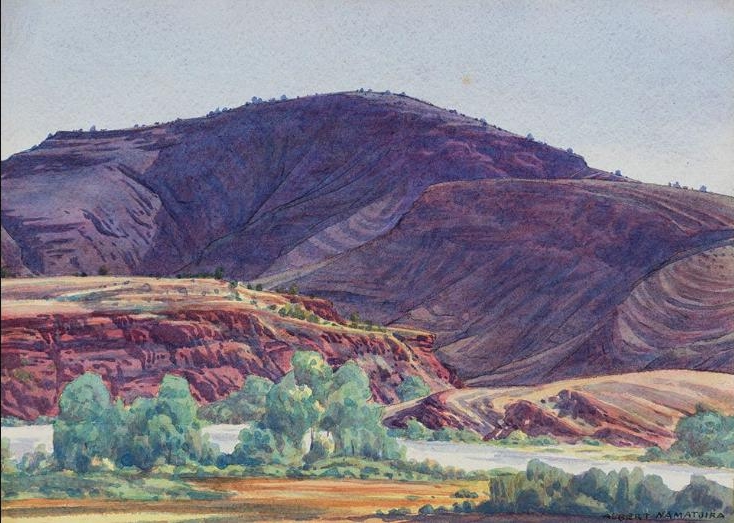
Albert Namatjira
[Mt Hermannsburg, James Range] c. 1943–44watercolour
Geelong Gallery, JH McPhillimy Bequest Fund, 1954
1954
1954 proved to be a busy year for Geelong Gallery, with multiple exhibitions as well as significant additions made to the permanent collection, including Mt Hermannsburg, James Range by Western Arrernte painter Albert Namatjira. This was the first work by a First Nations artist acquired for the permanent collection, and depicts a grand mountain range at Ntaria, Alice Springs.
In October 1954, Geelong Gallery held an exhibition of Aboriginal and Torres Strait Islander works, with various works being loaned from the personal collections of Geelong locals.
Janet Biddlecombe, a Geelong Gallery supporter and occupant of Shelford’s Golf Hill Homestead, died in this year, bequeathing Landscape by William McInnes as well as various items of antique furniture.
Part of these antiques was a square piano, now housed in the G M Hitchcock Gallery. This piece was purchased by James Morrison and Co, woolbrokers, of London in 1853, on behalf of George Russell, Janet’s father. Once it arrived in Geelong, it was then moved to Janet’s residence by Gibbs, Ronald and Co on a bullock drawn cart.
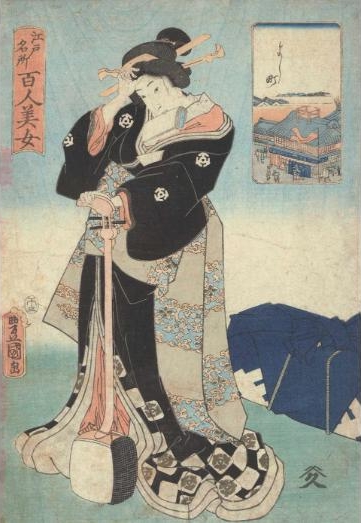
Utagawa Toyokuni
[Geisha with shamisen] 1815colour woodcut
Geelong Gallery
JH McPhillimy Bequest Fund, 1955
1955
In 1955, Geelong Gallery loaned Collins Street and A bush burial by Frederick McCubbin to the National Gallery of Victoria for a retrospective of the artist’s works.
Works on paper featured prominently in Geelong Gallery’s activity this year. Woodcuts and lithographs were acquired for the permanent collection, and a collection of prints was loaned by the National gallery of Victoria for the benefit of secondary school students in the Geelong region.
Among the year’s acquisitions were prints by Japanese artists Utagawa Hiroshige, Ichiyusai Kuniyoshi and Utagawa Toyokuni. These works are examples of ukiyo-e, a Japanese art form that literally translates to ‘pictures of the floating world’. Ukiyo-e are multi-coloured woodblock prints and paintings first produced during Japan’s Edo period, from the 17th-19th centuries, and which depict the fashions, tastes and lifestyles of the time.
Women were often the subjects of these prints, particularly performance artists like kabuki actors and geishas. Utagawa Toyokuni’s Geisha with shamisen depicts a Geisha holding a shamisen, a traditional Japanese three stringed instrument used to accompany folk performances.
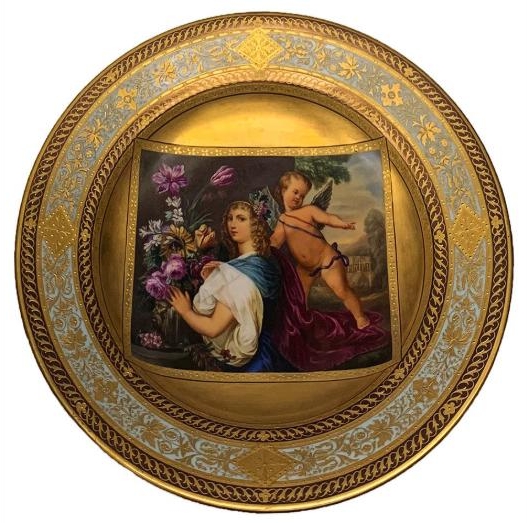
Royal Vienna style
[La belle et l’amour cabinet plate] 1790–1810hand-painted and gilded porcelain ceramic
Geelong Gallery
Gift of Charles D and the Late Mary James, 1956
1956
Geelong Gallery held various exhibitions in 1956 that reflected the strong creative community in Geelong.
Among these were the Geelong Society of Art Exhibition, the Geelong Society of Art Competition for school children and the Secondary Schools’ Exhibition of Arts and Crafts. Our 1956 annual report notes that the exhibitions attracted visitors who ‘otherwise would not have made the visit’, reflecting the popularity of local student art.
Charles D and the Late Mary James gifted a selection of ceramics, glassware and furniture to Geelong Gallery in this year, substantially enhancing the decorative arts collection.
The W Max Bell Gallery was officially opened after a three year effort to raise the necessary funds for its construction. Australian artist Daryl Lindsay was set to officiate the opening, but was called to Canberra to receive his knighthood, so Australian businessman and National Gallery of Victoria Trustee Aubrey Gibson took his place. Max Bell’s sister Gladys Bell cut the ribbon to Geelong Gallery in memory of her late brother.
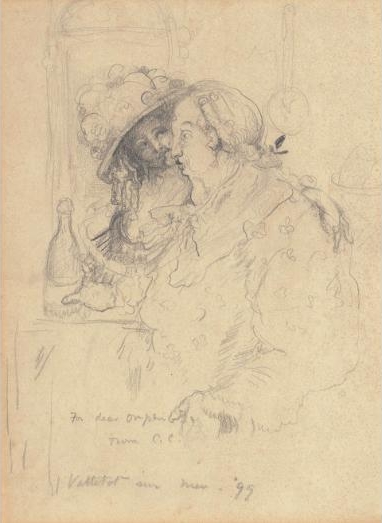
Charles Conder
[For dear Orphen] 1899pencil
Geelong Gallery
Gift of FE Richardson, 1957.
1957
In 1957, Geelong Gallery held an exhibition of Aboriginal and Torres Strait Islander art that included an array of paintings and decorative arts by First Nations artists such as Albert Namatjira, three of his sons, Enos, Ewald and Oscar, Richard Moketarinja, Gloria Moketarinja, Walter Ebatarinja, and Benjamin Landara among others.
Among the acquisitions in 1957 were two works by English-born Australian artist Charles Conder: For dear Orphen and Babies and swans through archway. Conder was a key figure within the Heidelberg School, an Australian Impressionist art movement that emerged during the late 19th century.
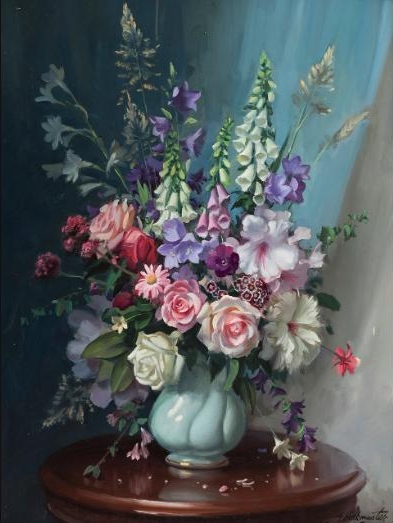
Ernest Buckmaster
[Flower study] c. 1940soil on canvas
Geelong Gallery
Gift of Miss Gladys Bell, 1958
1958
In 1958, Geelong local and longtime Geelong Gallery supporter Gladys Bell presented Geelong Gallery with Flower study by Ernest Buckmaster, an impressive oil painting capturing the refined skill and detail of Buckmaster’s work.
Gladys owned a property in Ocean Grove called Broome Cottage, which was awarded a National Trust heritage award for restoration works in 2021. Gladys was said to live an extravagant lifestyle, often travelling the world and once hiring a taxi to drive her from New York to Mexico.
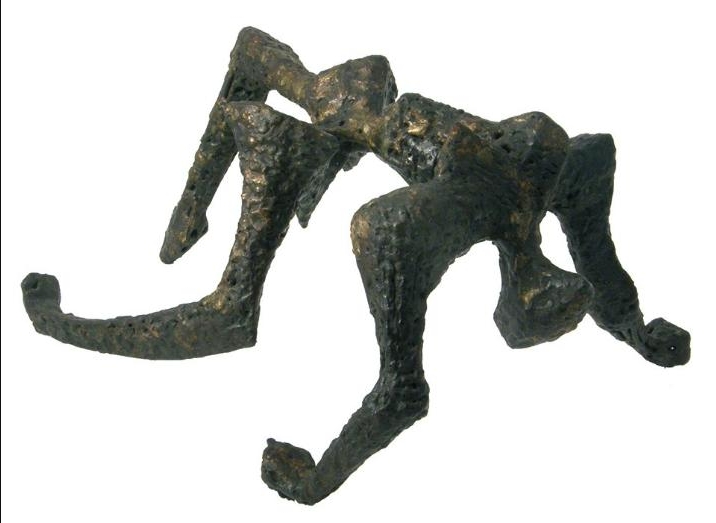
Lenton Parr
[Danae] 1957steel and bronze sculpture
Geelong Gallery
HP Douglass Bequest Fund, 1959
1959
1959 saw the relationship between Geelong Gallery and local schools continue to strengthen. Geelong Gallery exhibited works by students from Matthew Flinders Girls’ Secondary College, Geelong Grammar School and Geelong Technical School.
Among the acquisitions for this year was Danae by Lenton Parr, a steel and bronze sculpture depicting a reclining woman who emulates the Greek mythological princess Danaë. The bronze accents that decorate the top of the figure replicate the shower of gold that rains down on Danaë in the myth.
In a 1979 interview, Parr stated that the creation of Danae was a turning point in his career, demonstrating his ability to achieve his goals through small figurines rather than a purely abstract form. Parr credits Danae as being ‘one of the most significant things I’ve made’.
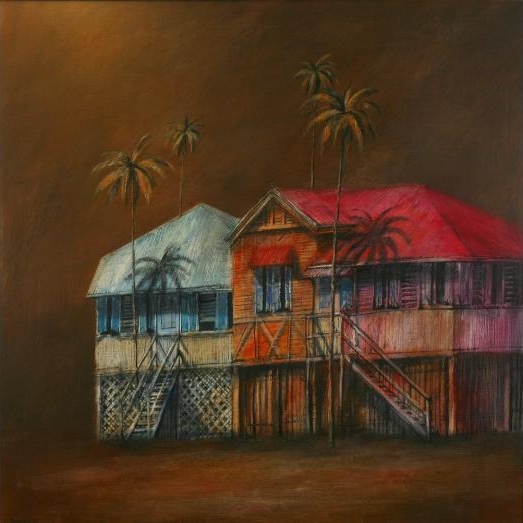
Michael Shannon
[High Noon] 1970oil on canvas
Geelong Gallery
Gift of Alcoa World Alumina Australia, 2008
© Courtesy of the artist’s estate
1960
1960 marked the construction of the Alcoa smelter at Point Henry. The smelter, which commenced production in 1962, manufactured aluminium right up until it was closed in 2014. The site is currently being decommissioned, and is expected to become a community site in the future.
Alcoa World Alumina Australia gifted several works to Geelong Gallery over the years, including this painting titled High Noon by Michael Shannon. This image depicts colourful beach bungalows juxtaposed against an otherwise barren setting, a mysterious light source illuminating the scene.
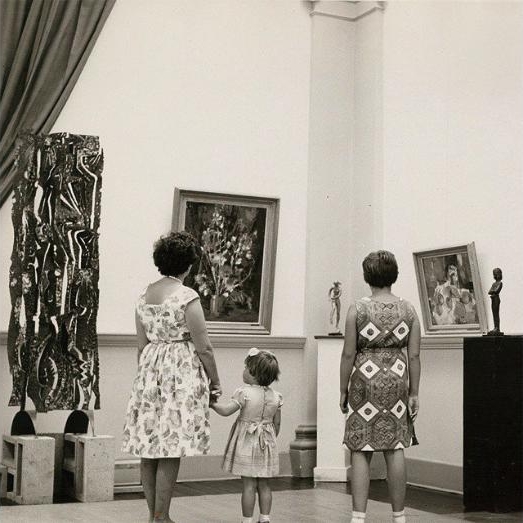
sepia photograph
Geelong Gallery archives.
1961
This image of three elegant visitors to Geelong Gallery highlights the distinct and iconic fashion of the ’60s. In fact, high heeled shoes were temporarily banned in the early ’60s due to damage to Geelong Gallery floorboards.
Visible to the right of the first image is William Harding’s still life Glass jar and golden pippins. Harding’s work highlights the effects of sunlight passing through a glass vessel and across the surrounding solid masses of the tablecloth and pippins, crisp tart apples of a greenish-yellow colour. Harding was awarded the 1961 Geelong Advertiser prize for this work.
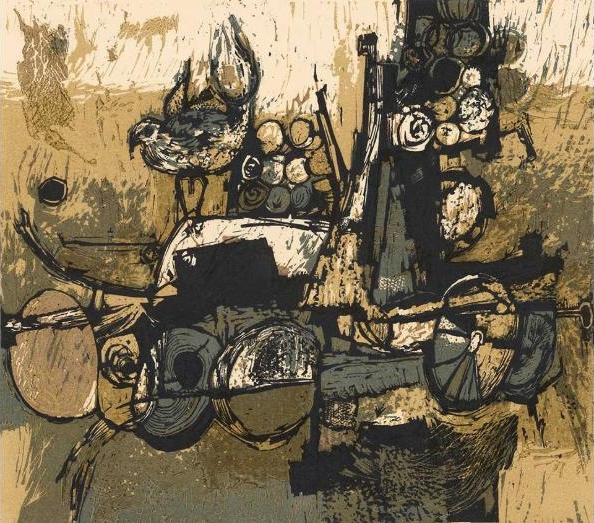
Daryl Carnahan
[Landscape with plough] 1962colour linocut; edition 9/10
Geelong Gallery
Mayor of Geelong prize, 1962
Photographer: Robert Colvin
1962
The Geelong print prize series began in 1962, when it was named the Mayor of Geelong prize.
The recipient in this first year was Daryl Carnahan for his work Landscape with plough. The prize was judged by Australian landscape and portrait artist, Laurence Scott Pendlebury.
This is considered to be the first prize for contemporary printmaking staged by an Australian public gallery, and it attracted artists from all over the country. The Geelong print prize series ran until 1974, with many iconic artists and judges participating. At one stage Geelong Gallery considered hosting an international print prize.
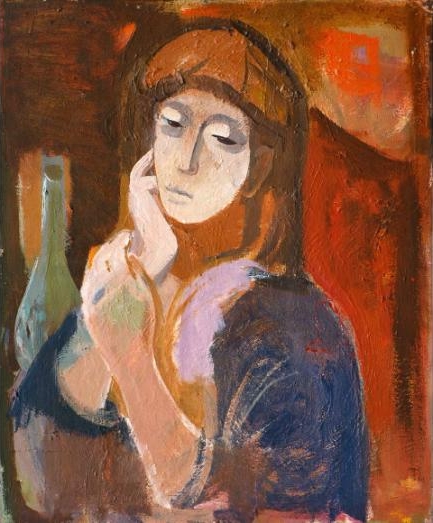
Constance Stokes
[Sorrowing mother] 1960oil on compositional board
Geelong Gallery
Purchased with the assistance of the Ford Motor Co, 1963
© Courtesy of the artist’s estate
1963
Long time Geelong Gallery supporter and former President of the Geelong Art Gallery Association Frank Evan Richardson passed away in 1963.
The son of former mayor, Horace Frank Richardson (who approved the Geelong Art Gallery Association), Frank joined the committee in 1929, was honorary secretary between 1930-46 and was the President from 1946 until a few months before his death.
In July 1963, a cocktail party was held so that J G McIntyre, the Managing Director of Ford Motor Company, could present Geelong Gallery with six works to be acquired for the permanent collection.
Among these works was Sorrowing mother by modernist Australian artist Constance Stokes. In this portrait, Stokes references religious iconography to pay tribute to her mother, who had died twenty-four years earlier in 1936.
Bearing a contemplative expression, the central figure represents, as the writer Andrea Loyd has observed, ‘a composite portrait of her mother, the woman mourning for her (Stokes) and in turn the sorrowing mother of Jesus’.
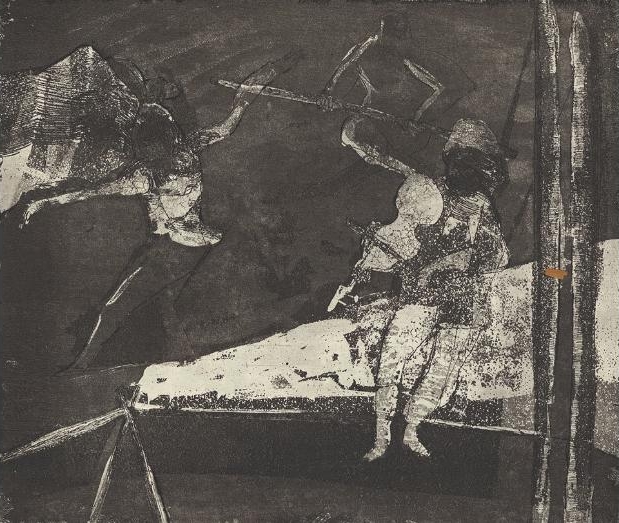
George Baldessin
[Rope walker] 1964Geelong Gallery
JH McPhillimy Bequest Fund, 1964
1964
In 1964 the Geelong Art Gallery Board decided that Geelong Gallery would shift its focus to the collection and promotion of contemporary Australian art, which was gaining popularity at the time, and that a permanent Education Officer would be established.
The role of Education Officer was filled by G Binns, an art teacher from the Geelong Teachers’ College and Geelong High School.
One of the acquisitions for the permanent collection this year was Rope walker by the young Italian-Australian artist George Baldessin. Baldessin was well known for his sculptural work and printmaking, considering the two mediums complementary to one another.
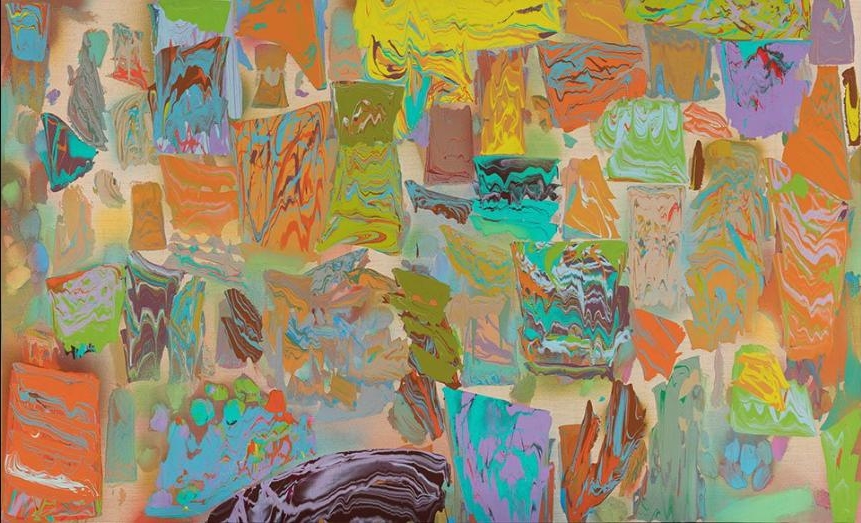
Victor Majzner
[Poolon] (1974)synthetic polymer paint on canvas
Geelong Gallery
Corio 5 Star Whisky purchase award, 1974
1965
Geelong Gallery held a film night in 1965, inviting guests to watch The Titan: Story of Michelangelo, a 1950 German documentary detailing the life of iconic Italian Renaissance artist Michelangelo.
To support the goal of representing more emerging Australian contemporary artists, the Geelong Art Gallery Association teamed up with United Distillers Ltd (who operated out of the Corio Distillery) to create the Corio 5 Star Whisky prize for oil painting. This allowed Geelong Gallery to acquire a contemporary work by an Australian artist each year.
Pictured is Poolon by Russian-born Australian artist Victor Majzner, which was awarded the Corio 5 Star Whisky prize in 1974, the last year of the prize. Majzner is known for his use of colour and the surreal quality of his works.
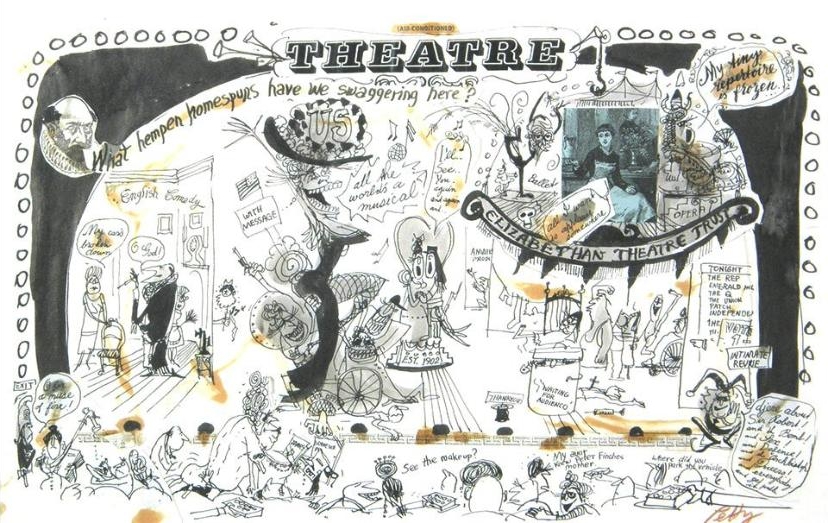
Bruce Petty
[Theatre] (early 1960s)pen and ink drawing
Geelong Gallery
Gift of the artist, 1966
Courtesy of the artist
1966
In 1966, Geelong Gallery raised $15,000 toward the construction of two new gallery spaces connecting Geelong Gallery to the Geelong Library, a main foyer that meets Little Malop Street and a loading dock, kitchen and lecture room on the eastern side of the building.
Geelong Gallery sought additional support from the Victorian Government to fund the new spaces. $50,000 was announced for the construction plans in the state budget, leaving Geelong Gallery only $10,000 to reach the project goal. Over the following three years, Geelong Gallery allocated additional capital funds to realise the upgrade.
1966 saw many new acquisitions to the permanent collection, including six works presented by political satirist and cartoonist Bruce Petty. Pictured is his pen and ink drawing Theatre, which offers an insight to the world of musical theatre through a satirical lens.
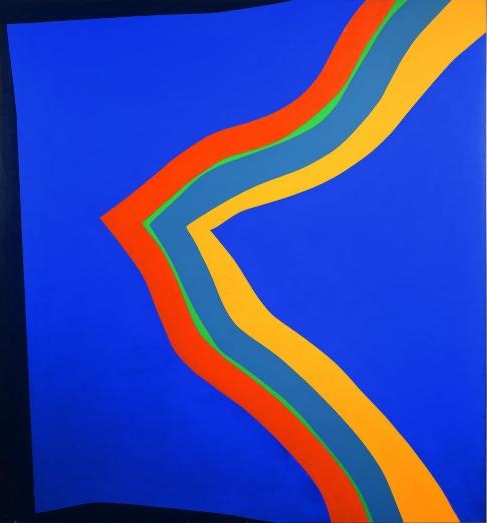
Sydney Ball
[Canzon nama] 1967synthetic polymer paint on canvas
Geelong Gallery, Corio 5 Star Whiskey prize 1967
1967
By 1967, cigarette companies were sponsoring many sectors of the community (reflecting the era), including Geelong Gallery’s exhibition Rodin and his contemporaries.
This exhibition featured a display of sculptures and drawings by French artist Auguste Rodin, as well as works by other French artists like Pierre-Auguste Renoir, Honoré Daumier and Aristide Maillol. The exhibition was ground-breaking, attracting 4,812 visitors to Geelong Gallery in only three weeks.
The 1967 recipient of the Corio 5 Star Whiskey prize was Sydney Ball for his iconic piece Canzon nama, one of our favourites here at Geelong Gallery.
Canzon nama belongs to Sydney Ball’s Persian series, a collection of abstract compositions developed between 1966 and 1968 driven by the ideals of colour, line and proportion. Works from this series aim to provide sensorial impressions of Middle Eastern architectural structures, rather than their figurative representation.
Ball belongs to a generation of Australian painters associated with the hard-edge painting style, with his works emphasising the flatness of pictorial surface and visible junctures between areas of high-keyed colour.
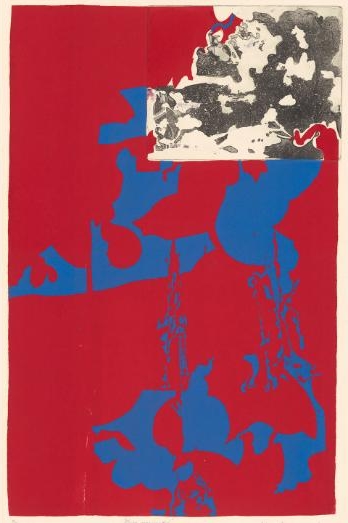
Andrea Num
[Being reanimated] 1968colour silkscreen inset with etching; edition 2/6
Geelong Gallery
Geelong print prize, 1968
1968
Geelong Gallery was still trying to raise an extra $10,000 needed for proposed building extensions in 1968, opting to find Australian sponsors for the project after American-owned companies like Ford Motor Company preferred to focus on organisations in the US.
The Geelong print prize had two winners this year: Australian artists Margaret A Elliott and Andrea Num for their works A cloud is a pillow (or description of my pillow) and Being reanimated. The prize was judged by the late Dr Ursula Hoff, the pioneering curator of prints and drawings at National Gallery of Victoria, who by 1968 was its Deputy Director.
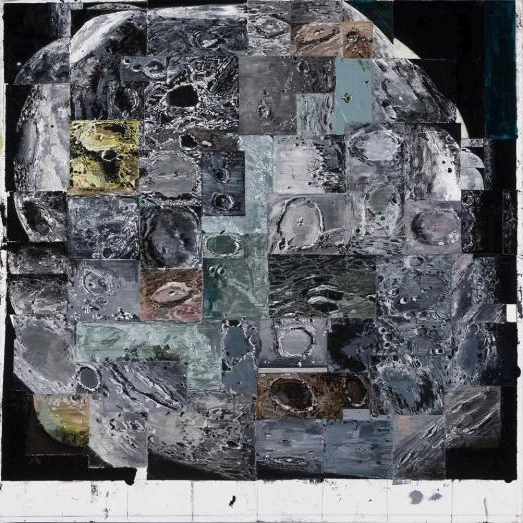
Stephen Rendall
[Nineteen sixty nine] 2019oil on canvas
Geelong Gallery
John Norman Mann Bequest Fund, 2019
© The artist
Courtesy the artist and Niagara Galleries, Melbourne
1969
In 1969, the United States won the space race when Buzz Aldrin and Neil Armstrong landed on the Moon.
Stephen Rendall’s work Nineteen sixty nine is a painting of collaged images derived from a commemorative publication marking the anniversary of the 1969 Moon landing, depicting the Moon and emphasising its grey tonal range.
His work reminds us that our experience of the Moon is largely a mediated one: we experience it through the lenses of telescopes, photography and film.
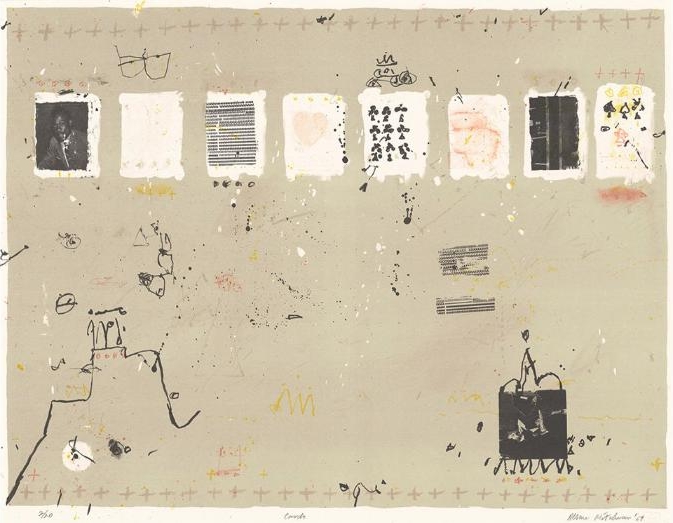
Allan Mitelman
[Cards] 1969lithograph, edition 2/20
Geelong Gallery
Geelong print prize, 1970
Courtesy of the artist
1970
Abstract artist Allan Mitelman won the Geelong print prize in 1970 for his work Cards.
Mitelman’s work was judged by the celebrated Australian painter John Brack. It depicts a row of playing cards surrounded by symbols, intuitive line work and gestural marks.
Mitelman himself said that ‘I don’t like pictures that describe things, so the marks are a denial of that. Both the crosses which border the edge…and occur outside the print…provide…a requisite measure of tomfoolery’.
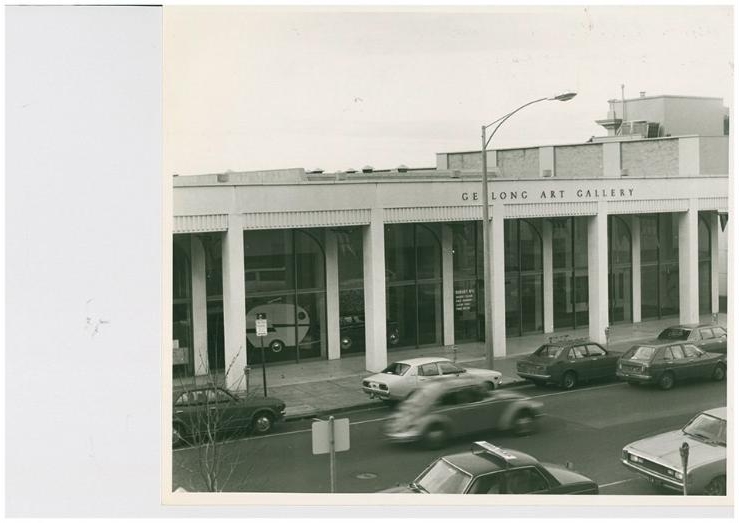
Unknown photographer
[Little Malop street facade] 1983colour photograph
Geelong Gallery
1971
1971 saw the opening of a new gallery space and the current foyer space, marking a new era for Geelong Gallery.
The new gallery was initially known as the Tiled Gallery, but it is now know as the Myer Gallery. The new foyer and Tiled Gallery were a contemporary update to Geelong Gallery’s architecture, and were designed by Buchan, Laird and Buchan, a firm including descendants of the architects of the G M Hitchcock Memorial Art Gallery, our first exhibition gallery.
This new era was also marked by the appointment of a new Director, Katrina Rumley. Rumley is an Australian arts administrator, curator and writer who had spent some time in Germany before moving back to Geelong to start her tenure at the newly re-opened Gallery.
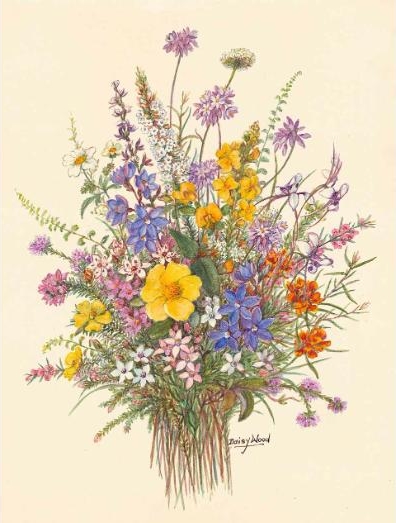
Daisy Wood
[Wild flowers] 1950s-60swatercolour
Geelong Gallery
Gift of anonymous donor, 1972
1972
In 1972 Geelong Gallery acquired Wild flowers by Australian botanical artist Daisy Wood. Wood was born in Wallington in 1894, when the area was still bushland. She recalls spending time roaming the bush with her parents and sister, forging her love for nature at an early age.
Wood went on to become a well-known botanical and landscape artist, drawing intricate and detailed works of the Australian landscape and native and non-native flowers. Wild flowers is a testament to her skill and highlights the beauty of her botanical works.
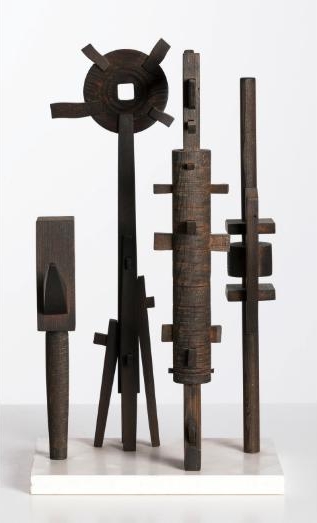
Vincas Jomantas
[Maquette for Procession] 1981timber on particle board base
Geelong Gallery
Gift of Mrs Laima Jomantas, 2004
1973
Geelong Gallery held a sculpture exhibition in 1973, displaying the work of a group known as Centre Five.
Centre Five was made up of five Europe-born sculptors (Vincas Jomantas, Clifford Last, Inge King, Julius Kane and Teisutis Zikaras) and two Melbourne-born sculptors (Lenton Parr and Norma Redpath) who were united in their interest in advancing modernist sculpture in Australia.
Geelong Gallery’s exhibition surveyed the works of Jomantas, Last, King, Parr and Zikaras, and was exhibited alongside a collection of contemporary prints by American artists.
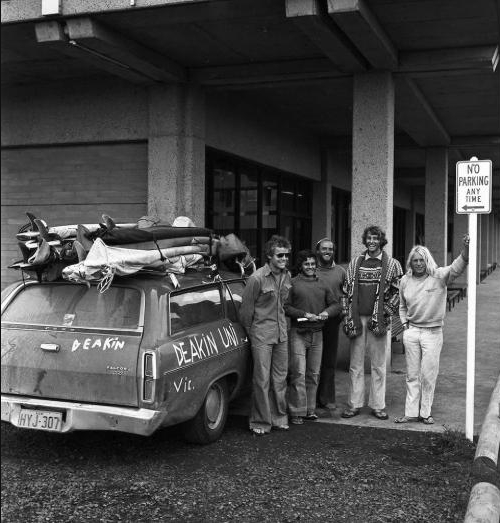
Image courtesy of Deakin University
1974
Deakin University was established at Waurn Ponds in 1974, becoming the first university to be established in regional Victoria and the first to specialise in distance education.
Deakin’s first students started in 1977, and these students were photographed in 1980. Deakin is now a well established university with campuses in Warrnambool and Burwood, and has been a close collaborator of Geelong Gallery’s for many years.
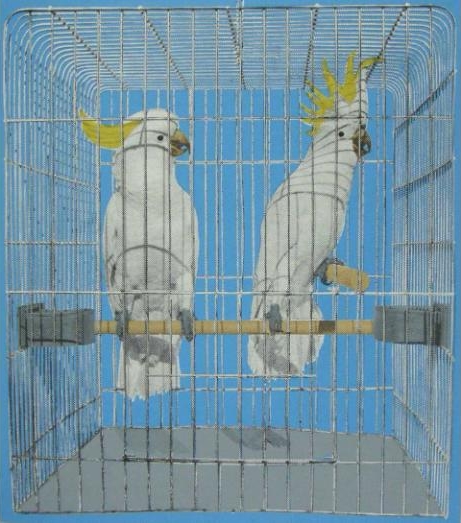
Sally Robinson
[Cockatoos] 1975colour photo-screenprint; edition 9/65
Geelong Gallery
Member print, Print Council of Australia, 1975
1975
In 1975 Katrina Rumley completed her term as Director and was succeeded by Margaret Rich, who served as Director until 1980.
Cockatoos by Australian artist Sally Robinson was acquired in this year. Robinson is well-known for her portraiture, design, painting, and printmaking. Cockatoos typifies Robinson’s expertise with the screen print technique, and her representation of Australian fauna and flora, and her depiction of landscapes.
Robinson has always been interested in photography, however she has said that she found it ‘difficult to say all that was necessary about a scene in a single photograph, [so] screenprinting appealed as it [allowed] the production of an image that is photographically based but with the option of severe manipulation.’
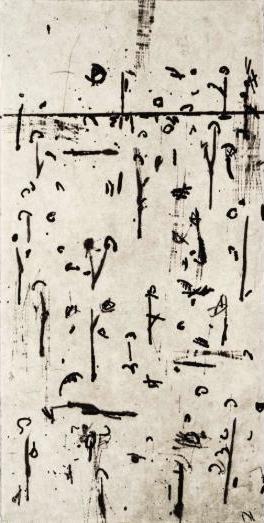
Fred Williams
[Decorative panel, You Yangs number 3] 1965-66etching and engraving; edition 6/25; state 2/2
Geelong Gallery
Gift of the artist, 1976
Courtesy of the Estate of Fred Williams
1976
1976 was a year of significant additions to the permanent collection, with the acquisition of eight works by Australian artist Fred Williams (1927-1982).
Born in Richmond, Melbourne, Williams is acclaimed as one of the most influential painters of Australian landscapes. He held more than 70 solo exhibitions throughout his career. You may recall our 2017 exhibition Fred Williams in the You Yangs, which brought together Williams’ groundbreaking interpretations of the You Yangs from the early 1960s to the mid 1970s.
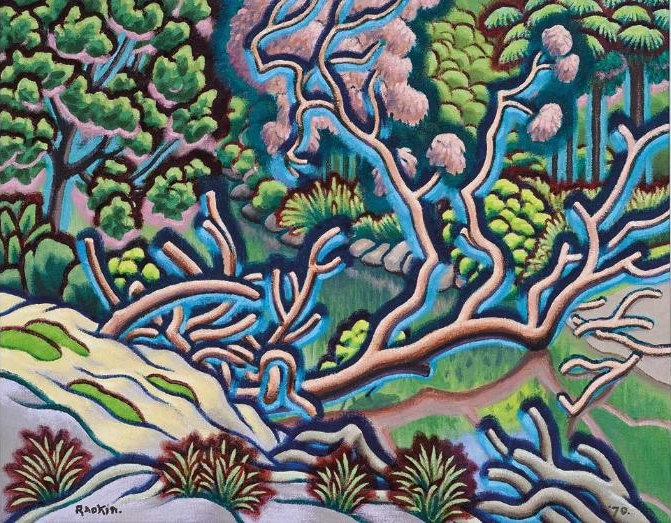
Weaver Hawkins
[The dying tree] 1970oil on board
Geelong Gallery
Purchased 1977
1977
In 1977 Geelong Gallery acquired two works by British-born artist Weaver Hawkins, the same year of his passing. The works acquired were A dying tree and The bath. The bath depicts a woman bathing her baby, an exceptional example of Hawkins’ skill with line and colour.
Hawkins was known for his work in monotypes, etching, woodcuts and linocuts, with his works depicting domestic scenes and figures, but also ‘ambitious, sometimes mural-sized, modernist allegories of morality for an age of atomic warfare and global over-population’.
Additionally in the late 1970s, the Australian Federal Government’s Cultural Gifts Program was established to encourage private collectors to donate significant works to public galleries.
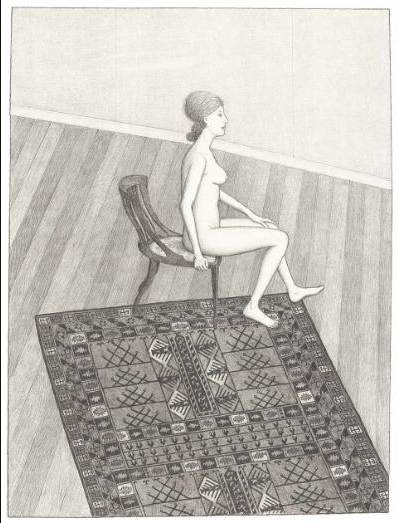
John Brack
[Nude in profile] 1978lithograph
Geelong Gallery
Gift of Laurence O’Keefe and Christopher James, 2015
1978
In 1978, a committee was formed in Melbourne to restore Bodford Terrace (also known as Bedford Terrace), one of the city’s earliest Victorian-era terraces.
Bodford Terrace was built in 1868 and went through stages of appreciation and neglect before being recognised as an important heritage building in the late 1970s.
In support of its restoration, the Bodford Terrace Restoration Committee engaged eight high profile artists to produce a print in an edition of 300 published by Druckma Press, and printed by Neil Leveson and John Robinson.
Among these works was Nude in profile by Australian artist, John Brack, which was acquired by Geelong Gallery in 2015. Other commissioned artists for this project included Leonard French, John Olsen, Frank Hodgkinson, George Baldessin, Clifton Pugh, Franz Kempf and Les Kossatz.
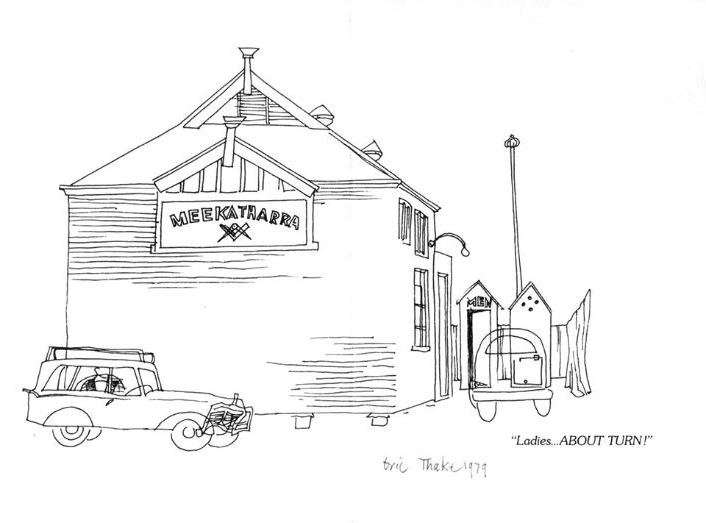
Eric Thake
[Ladies … about turn!] 1979lithograph
Geelong Gallery
Purchased with funds generously provided by the Friends of the Geelong Gallery and the Gallery Grasshoppers, 1986
1979
The Friends of the Geelong Gallery was established in 1979, beginning as a group of Geelong Gallery subscribers passionate about supporting Geelong Gallery and enhancing community engagement. One of their suggestions was ‘Sundays at the Gallery’, a weekly program of activities and educational opportunities.
Over the years, the Friends also helped raise funds for 53 acquisitions to the permanent collection, including 40 works by Australian artist Eric Thake, purchased jointly with the Gallery Grasshoppers in 1986 (another of Geelong Gallery’s key past support groups).
The Friends of the Geelong Gallery disbanded in 2019, but their influence and great work is still evident in our collection today.
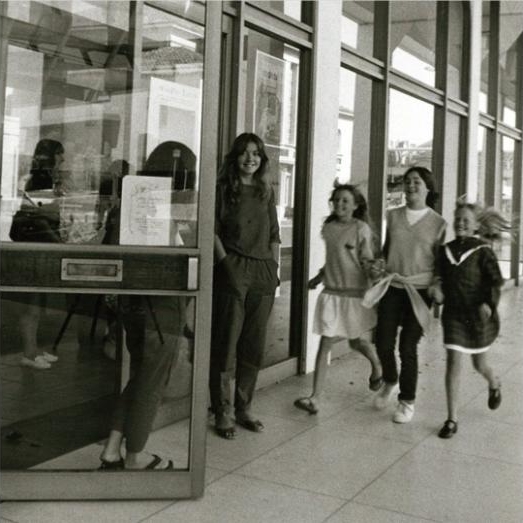
sepia photograph
Geelong Gallery archives
1980
Margaret Rich finished her tenure as Director in late 1980, and was succeeded by Pamela Ann Gullifer, who served until 1984.
This image from Geelong Gallery archives shows some local children enjoying Geelong Gallery at the Little Malop Street entrance, almost ten years after it had been opened.
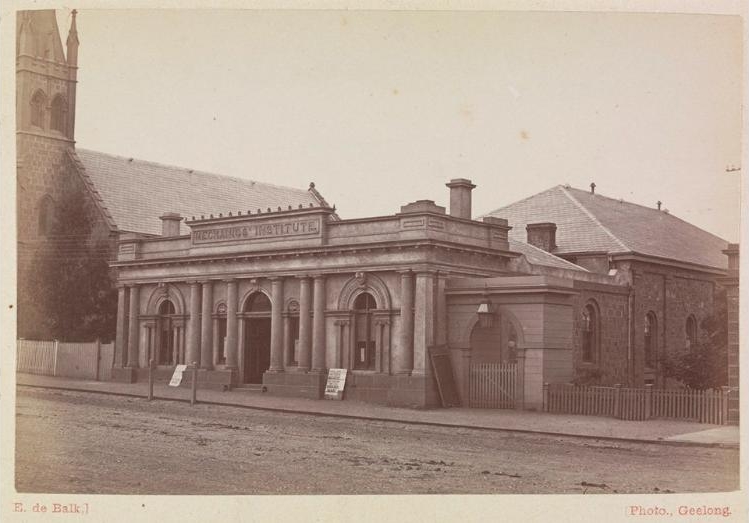
Eugen de Balk
[Mechanics’ Institute. Geelong] 1866albumen silver photograph
State Library Victoria
1981
The Geelong Arts Centre was officially opened in April 1981 as Geelong Performing Arts Centre, a haven for new and emerging performing arts talent in our community.
Part of GPAC ran out of the old Mechanic’s Institute, which was originally built as a wooden building on Malop Street in 1846. After moving around Geelong, the institute settled on its Ryrie Street premises in 1856. This was where all the town’s art exhibitions were held before Geelong Gallery was founded in 1896.
After the building was devastated by fire in 1927, it was rebuilt as the Mechanic’s Hall in 1928. Soon the Mechanic’s Hall became a cinema known as the Plaza Theatre, and then eventually became GPAC.
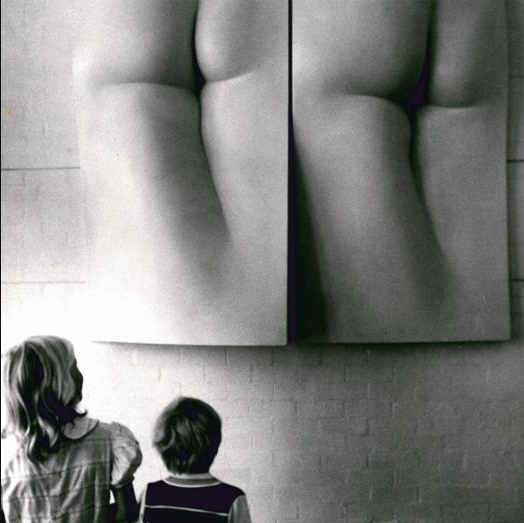
Unknown photographer
[Peter Corlett’s ‘Bums’ on display] c. 1982black and white photograph
Geelong Gallery
1982
Numerous works were acquired for the permanent collection in 1982, including six watercolours, seventeen oil paintings, nine drawings, nine prints, two sculptures, and one item of colonial silver. Thirty-three contemporary ceramics were also acquired as gifts of or purchases supported by Gordon Jackson.
Among the acquisitions in 1982 was Peter Corlett’s painted fibreglass sculpture, Bums, donated to Geelong Gallery by Manny and Etta Hirst, and enthusiastically enjoyed by Geelong Gallery visitors of all ages, as visible in this photo from the archives.
The Geelong Gallery Grasshoppers also began operating in 1982. The Grasshoppers were a group of dedicated art lovers whose fundraising and social events over three decades made a lasting impact on the life of Geelong Gallery. The Grasshoppers began sponsoring the Geelong acquisitive print awards in 1996. The Grasshoppers retired in 2016, and purchased the late Mandy Martin’s 1987 painting Beyond Eden as a parting gift to the collection.
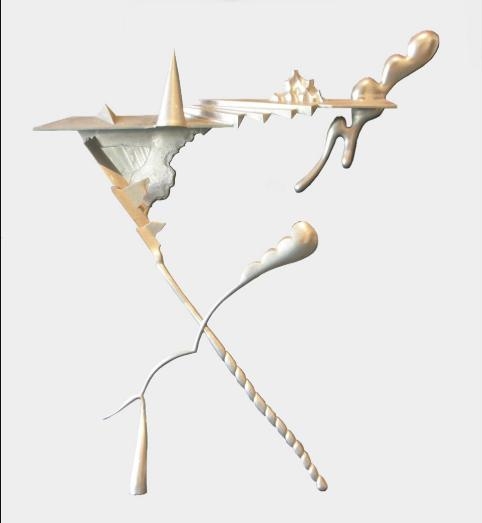
Jock Clutterbuck
[Cave of Wiswas] 1980cast aluminium sculpture
Geelong Gallery
Gift of Dr and Mrs Bruce Munro, 1981
1983
During the early 1980s, Dr Bruce Munro and Judy Munro gifted over twenty works to Geelong Gallery by some of Australia’s most highly acclaimed sculptors, including Bertram Mackennal, Ron Robertson-Swann, and Inge King.
In 1982 eight artists were short-listed to prepare maquettes for the 1982 Ian Potter Foundation Prize. Geoffrey Bartlett’s Messenger was selected and installed in the National Gallery of Victoria’s moat in 1983 and remained there until 2003 when it was relocated to the NGV International’s sculpture garden moat. The maquette of Bartlett’s work was one of the Munro family’s donations to Geelong Gallery.
Jock Clutterbuck’s Cave of Wiswas was also gifted by the Munro family. In a 1980 artist’s statement, Clutterbuck explained that ‘Wiswas is an Arabic word to describe the zone of confusion which cloaks events here in the present moment as they appear and become the past’.
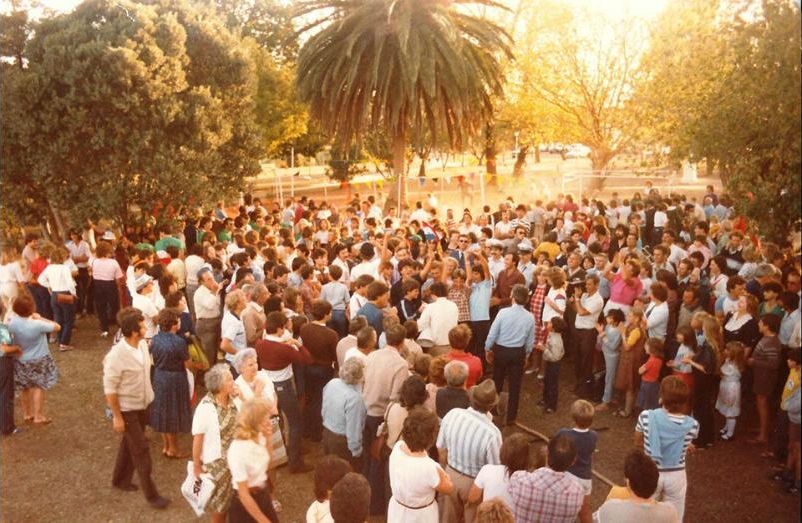
Image courtesy of Pako Festa, Diversitat
1984
The Geelong Gallery Foundation was established in 1984. The Foundation has been integral to raising funds for Geelong Gallery for decades, and has supported the acquisition of over 100 collection works since its establishment (including those acquired through the Geelong contemporary art prize between 1996 and 2002).
The second staging of Geelong’s well-known and beloved Pako Festa was held in 1984. The festival was first established by the Ethnic Communities Council Inc. in conjunction with the Geelong West Traders and Geelong West City Council.
The very first Pako Festa in 1983 attracted 12,000 participants and is said to have ended with a tug of war. The event now reaches crowds of 100,000 brought together to celebrate Geelong and Victoria’s diverse cultures.
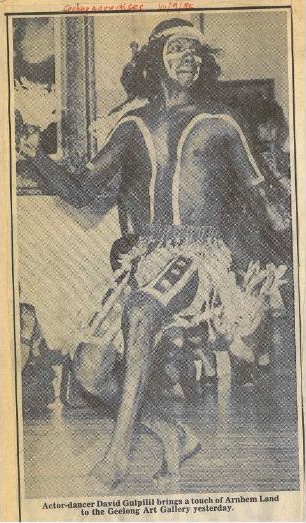
Unknown photographer
David Gulpilil 1985
Geelong Advertiser
1985
Geelong Gallery held many events and exhibitions during 1985, including a fundraising auction of antiques and collectables, and an exhibition of Aboriginal and Torres Strait Islander works.
Geelong Gallery also celebrated NAIDOC week with a dance performance by acclaimed Yolŋu dancer and actor David Dalaithngu and co-performers.
Dalaithngu and his dance group were on a year-long tour of Australia performing traditional dance from their home of Ramingining. Their aim was to showcase and educate groups at schools and organisations about their culture.
Please note: Aboriginal and Torres Strait Islander People should be aware that this page contains the name of a person who has since passed away
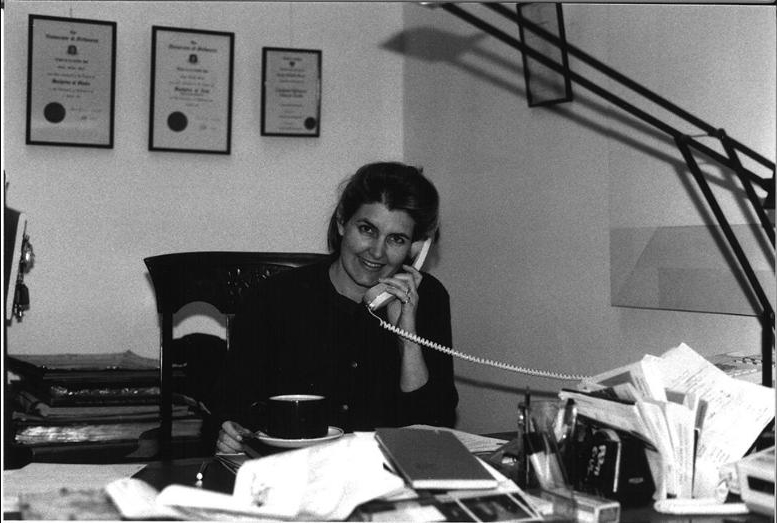
Unknown photographer
[Susie Shears in Director’s office] c. 1986–98black and white photograph
Geelong Gallery
1986
Director Susie Shears began her role in 1986 and led Geelong Gallery until 1998. Shears now holds the position of Cultural Collections Coordinator at The University of Melbourne.
Geelong Gallery’s first computer was purchased as a new technological age began. The IBM computer simplified operations, and also had the Victorian Public Galleries Cataloguing System software, enabling the permanent collection to begin its digital life.
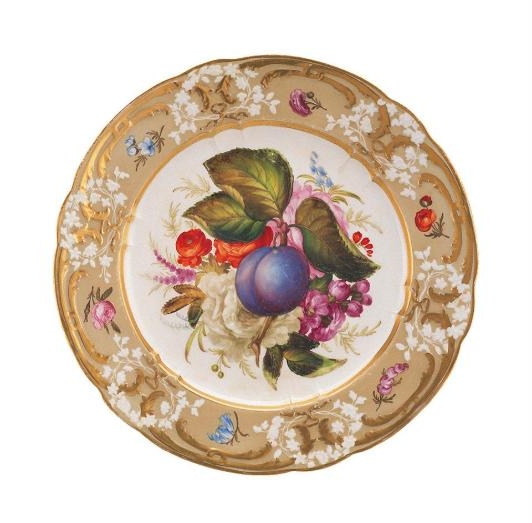
Coalport
[Fruit plate] c1820hand painted and gilded porcelain
Geelong Gallery
Dorothy McAllister Bequest Fund, 1991
1987
In 1987, Geelong Gallery received the generous Dorothy McAllister Bequest, which added an extensive collection of decorative arts to the permanent collection – including several by the popular Geelong porcelain painter Florence Royce – and a significant financial legacy.
Dorothy McAllister was a prominent local citizen, and a staunch supporter of Geelong Gallery. The terms of her bequest have a distinctly local focus on the acquisition of colonial Victorian silver, and a wider view to the acquisition of painted British, Welsh and Irish porcelain from the period 1750 to 1850.
The Dorothy McAllister Bequest Fund has supported the acquisition of gold rush-era Australian metalwork by Charles Brownlow and Edward Fischer (as well as rare archival material pertaining to Fischer’s life and career in Geelong), and contemporary porcelain by Australian artists including Gwyn Hanssen Pigott.
Pictured are some Coalport decorative plates acquired for the permanent collection through the Dorothy McAllister Bequest Fund in 1991. The Coalport manufactory produced tablewares with designs featuring moulded edges that emulated similar designs found on Welsh examples from Nantgarw and Swansea.
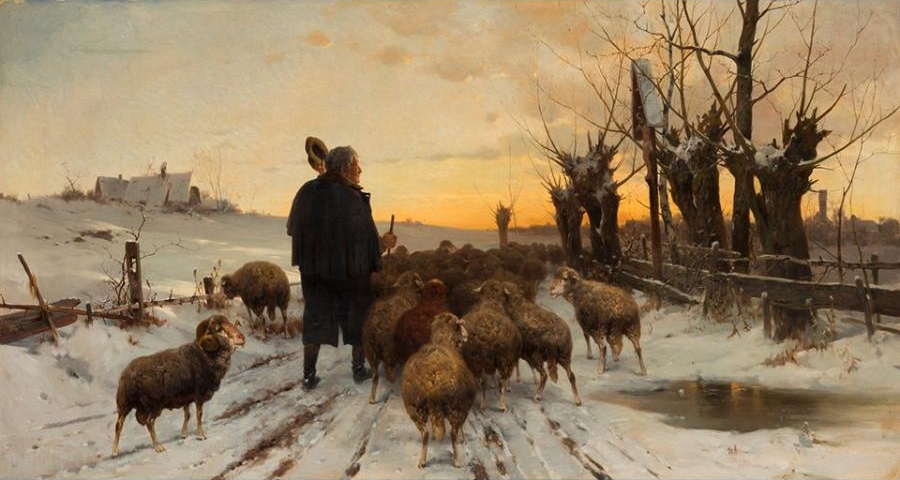
Ernst Meilsner
[Shepherd and sheep] late 19th centuryoil on canvas
Geelong Gallery
Gift of Mrs HA Austin, 1939
Photographer: George Stawicki
1988
The National Wool Museum was established in 1988 as Australia’s only museum to comprehensively survey the history of wool.
Geelong has long been known as a hub for manufacturing, with its railway and shipping routes helping shape its nickname ‘Pivot City’. Many woollen mills operated out of Geelong, the earliest being established in 1868.
The bluestone building housing the National Wool Museum was formerly the Dennys Lascelles Wool Store, built in 1872.
Pictured is Shepherd and sheep by Ernst Meilsner created in the late 19th century and acquired by Geelong Gallery in 1939.
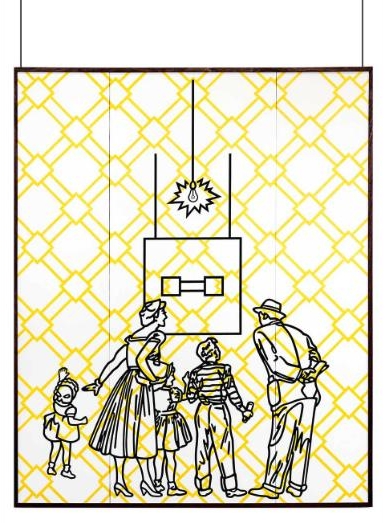
Geelong Gallery
Scotchmans Hill Vineyard art prize, 1989
© Courtesy of the artist and Anna Schwartz Gallery
Photographer: George Stawicki
1989
The first Scotchmans Hill Vineyard art prize was awarded in 1989. The recipient of the prize was contemporary Australian artist Peter Tyndall, selected by eminent curator and art historian Daniel Thomas.
Tyndall is well known for his use of bold line, text and stylised illustrations that draw on popular culture. His works invite us to consider the very act of looking at works of art and the cultural contexts for their display. The composition of this winning work effectively replicates – and heightens our attention to – the physical experience of viewing the work itself.
Integral to Tyndall’s work is the hanging mechanism and the formatted label that accompanies its presentation (presented here in the second image): text that makes reference to ‘cultural consumption’ and ‘production’. In other words, our viewing of the work he has created.
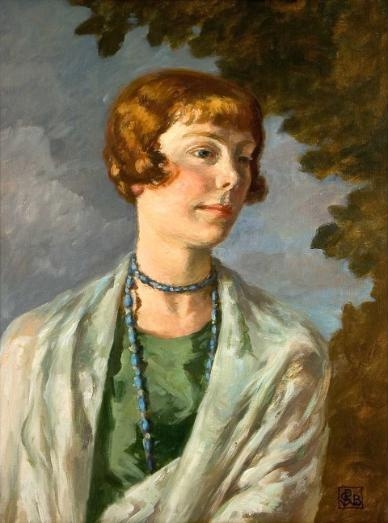
Rupert Bunny
[Portrait of Sybil Craig] 1928oil on canvas
Geelong Gallery
Bequest of Sybil Craig, 1989
1990
In 1990, Geelong Gallery received the second tranche of works from the bequest of prominent Melbourne artist, Sybil Craig, who passed away the previous year.
Craig became an official war artist in 1945, appointed by the Australian War Memorial. Through her role, she became the first female artist to depict women at work in munitions factories: specifically the Commonwealth Explosives Factory in Maribyrnong.
Fellow Melbourne artist Rupert Bunny painted this portrait of Sybil in 1928, and Geelong Gallery acquired it through the Bequest in 1989. Also pictured is one of Craig’s studies of the workers in the munitions factories.
The Sybil Craig Bequest continues to provide funds for the acquisition of works on paper.
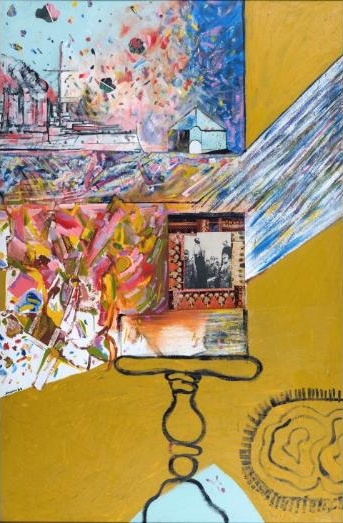
Gareth Sansom
[The green pavilion] 1966oil, enamel, pencil, pastel, oil crayon and photolithograph collage on composition board
Geelong Gallery
Gift of Allan Mitelman, 1991
1991
In 1991, Australian artist Allan Mitelman gifted two works by fellow Australian artist Gareth Sansom, The green pavilion and Study for a portrait II.
Depicted in the upper section of Study for a portrait II is Gareth Sansom’s friend and fellow Melbourne-based artist, the bearded Stuart Black (1937–2007). Sansom met Black in 1966 after Black tried to crash Sansom’s house party. They would then occasionally meet at Toorak Teacher’s College (later Melbourne State College), and soon Sansom became a regular dinner guest at Black’s Prahran house.
Black lectured at the Melbourne College of Advanced Education in its different guises from 1967 to 1982 and his legacy remains at the Victorian College of the Arts through the Stuart Black Memorial Bursary, Stuart Black Travelling Scholarship, and the Stuart Black Memorial Drawing Scholarship.
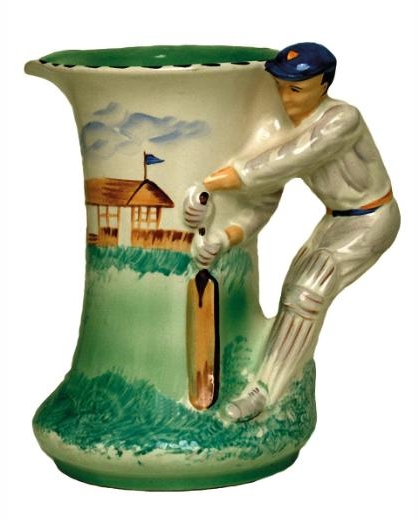
Burgess & Leigh (Burleigh Ware)
[‘Cricketer’ flower jug] 1930sembossed and hand-painted earthenware
Geelong Gallery
Gift of Dr HD Chamberlain, 1995
Photographer: George Stawicki
1992
From 1992 and through the remainder of the 1990s, Dr H David Chamberlain donated over 1,500 items of British art pottery from his substantial collection.
Pictured is ‘Cricketer’ flower jug, a ceramic form made by Burgess and Leigh (Burleigh Ware), a pottery manufacturer from Stoke-on-Trent, England. This popular work was donated by Chamberlain in 1995.
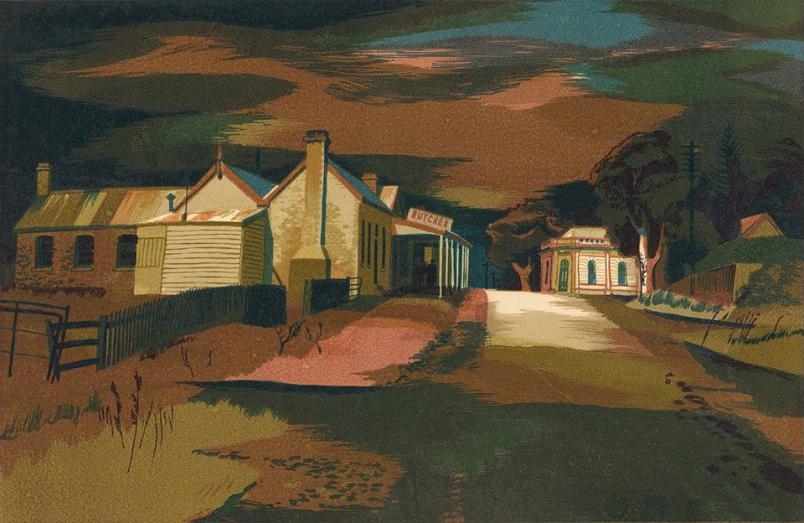
Kenneth Jack
[Shops on the hill, Drysdale, Victoria] 1959colour linocut, edition of 30
Geelong Gallery
HP Douglass Bequest Fund, 1962
© Courtesy of the artist’s estate
1993
In 1993, the Rural City of Bellarine was abolished and merged into the City of Greater Geelong. Before the merger, their seat was in Drysdale, a town with intriguing beginnings.
In 1848 Scottish-Australian farmer Anne Drysdale and her partner Caroline Newcomb acquired a 10,000 acre property in the Bellarine area and built the homestead ‘Coryule’ (also spelt Coriyule).
Slowly the rural town of Drysdale began to grow, and the pair were active members of the community. Anne died in 1853, and Caroline continued to run Coryule until her death in 1874.
The two were buried together at Coryule, but have since been moved to Eastern Cemetery, Geelong. Coryule homestead still stands today and is heritage listed.
Kenneth Jack’s Shops on the hill, Drysdale, Victoria depicts Drysdale’s main street in 1959. Jack’s work is a linocut printed in colour inks from six blocks, and produced in an edition of 30.
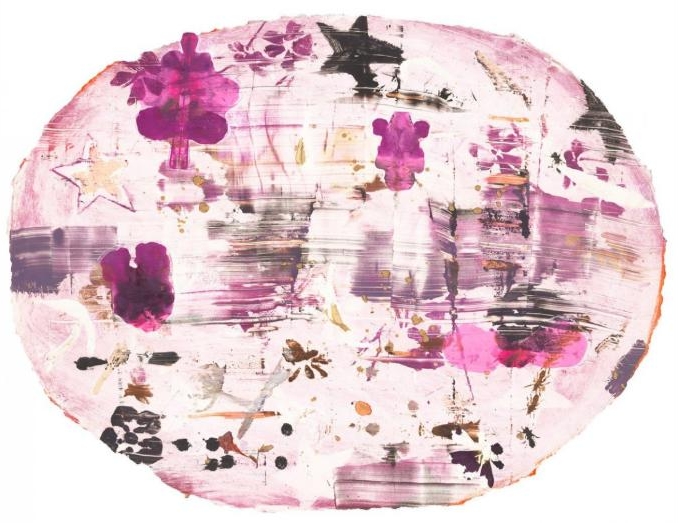
Sally Smart
[Study for ‘Hilma’s violets’] 1993synthetic polymer paint, oil and pressed flowers on paper
Geelong Gallery
Gift of the artist, 1994
Courtesy of the artist
1994
In 1994 Australian contemporary artist Sally Smart donated three works from her exhibition Where I come from the birds sing a pretty song, which was held at Geelong Gallery in 1993.
The first work pictured is Study for ‘Hilma’s violets’. Hilma af Klint (1862–1944) was a Swedish artist and mystic who, during seances, produced a series of ‘automatic’ drawings and paintings, to which Smart refers in her painted and collaged work on paper.
The second work, Bird #1 – Working drawing for “Where I come from the birds sing a pretty song”, is a surrealist collage melding avian and human forms. The title is a reference to a scene in David Lynch’s 1992 television series Twin Peaks.
Study for ‘The Fox sisters’ is a depiction of three sisters from New York who played an important role in the Spiritualist movement. Leah, Margaretta, and Catherine enjoyed careers as mediums for many years until 1888 when they admitted their ‘spirit rappings’ were a hoax.
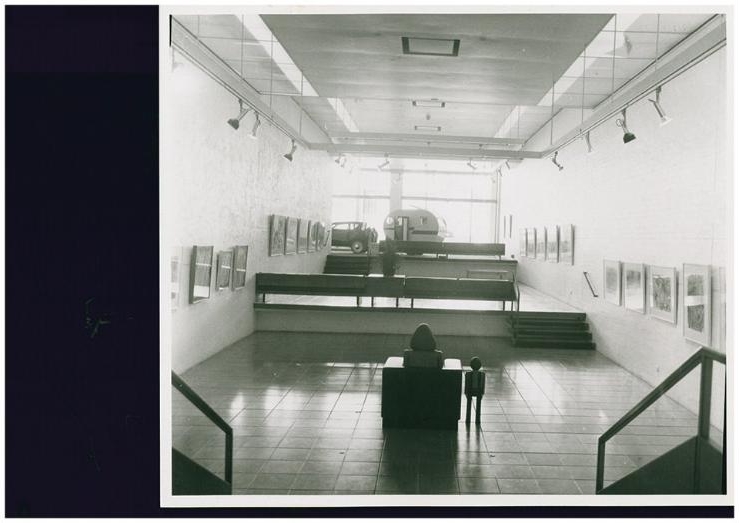
Unknown photographer
[Tiled gallery, Geelong Gallery] 1983black and white photograph
Geelong Gallery
1995
In 1995 Geelong Gallery underwent an expansion in its basement level to incorporate a Decorative Arts Gallery, and to enlarge paintings storage. This expansion also included the construction of the first floor administration offices.
A renovated Tiled Gallery was also re-opened and renamed the Sidney Myer Gallery after well-known Australian businessman, Sidney Myer, founder of Myer department stores. The Myer family have been longtime Geelong Gallery supporters.
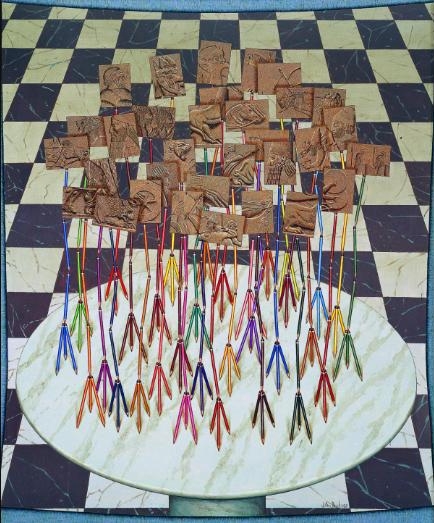
John Brack
[The hunt] 1988oil on canvas
Geelong Gallery
Geelong Art Gallery centenary acquisition
Purchased through public subscription, 1996
© Geelong Gallery and Helen Brack
Photographer: George Stawicki
1996
Geelong Gallery celebrated its centenary in 1996. According to the 1996 Annual Report, Geelong Gallery hosted a variety of events to celebrate the occasion, including a cocktail party with Governor of Victoria-designate Sir James Gobbo AC CVO QC as guest of honour.
Geelong Gallery’s centenary acquisition was The hunt by acclaimed Australian artist John Brack. This acquisition was made possible through generous donations from the public as well as the Geelong Art Gallery Foundation.
1996 was also the inaugural year of the Geelong contemporary art prize, with Australian artist John Nixon being awarded the prize for his work Black + orange cross. The first year of this prize saw 550 submissions, with Director Susie Shears and Curator Anne Carew selecting the works of 26 finalists for exhibition.
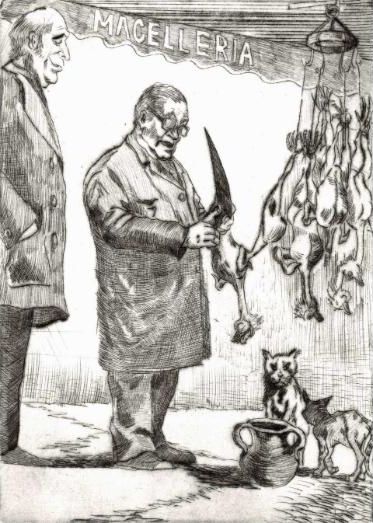
Eolo Paul Bottaro
[Macelleria, Sicilia] 1997Etching; edition artist’s proof
Geelong Gallery
Geelong print prize, 1997
Courtesy of the artist and James Makin Gallery, Melbourne
1997
1997 was the first year of our nationally acclaimed Geelong acquisitive print prize (now known as the Geelong acquisitive print awards). Thanks to the generous sponsorship of $3000 from the Gallery Grasshoppers, Geelong Gallery was able to acquire six works from artists Pat Brassington, Tate Adams, Eolo Bottaro, David Frazer, John Ryrie, and Imants Tillers.
Australian artist Lindy Lee won the 1997 Geelong contemporary art prize for her work Pointing east, pointing west. At the time, Lee appropriated and recontextualised images from Old Master paintings in grids also exploring abstraction and the void. Using a photocopier, and altering tonal levels, Lee controlled the presence and disappearance of her subjects.
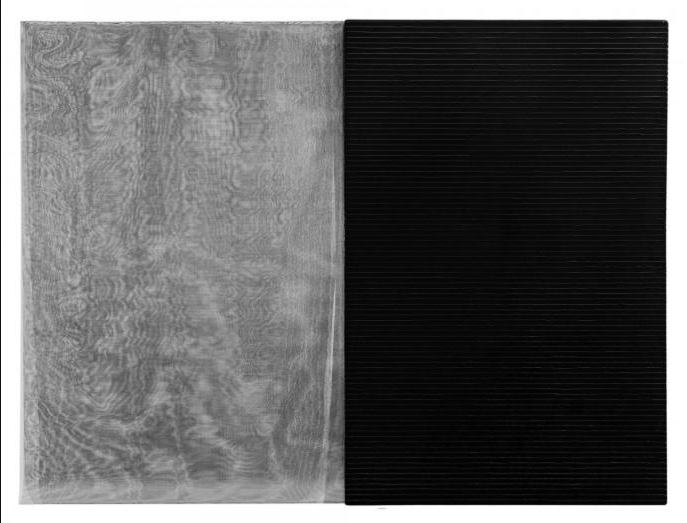
Janenne Eaton
[Screen and reflections: The Never Never] 1998enamel on wood panel, fibreglass mesh and perspex rod
Geelong Gallery
Geelong contemporary art prize, 1998
Sponsored by the Geelong Art Gallery Foundation
© Courtesy of the artist
Photographer: George Stawicki
1998
In 1998 Geelong Gallery connected to the internet for the first time and established its first email address.
Australian artist Janenne Eaton won the 1998 Geelong contemporary art prize for her work, Screens and reflections: The Never Never. Eaton’s works are well known for taking inspiration from her explorations into the Australian landscape and our perceptions of it, with the Never Never being a term for the vastness of the Australian outback. The reflection of the viewer in the lustrous black surface suggests their fleeting occupation of space, or the land.
Artist, theorist and curator Charles Green stated that Eaton’s ‘irregular measurements, broken lines and imperfect tonal shifts constantly returned the viewer to the painting’s surface…As the viewer looks into the mesmeric movement of light across the screen, the possibility of something beyond comes into being’.
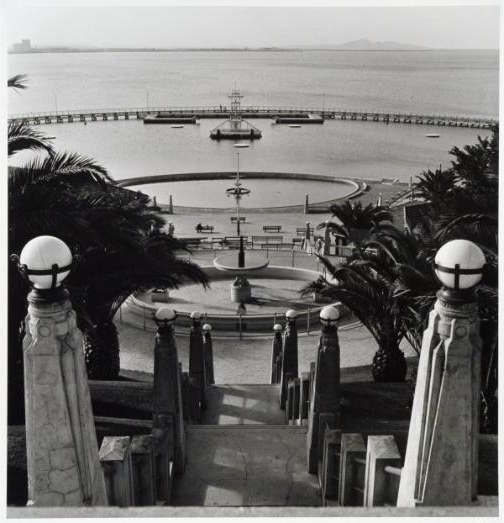
Max Dupain
[Eastern Beach, Geelong] 1946black and white photograph, edition 11/90
Geelong Gallery
Sybil Craig Bequest Fund, 1999
Photographer: George Stawicki
1999
In 1999 Director Susie Shears finished her tenure, being succeeded by Geoffrey Edwards, who remained in the role until 2016.
1999 also saw Geelong Gallery acquire Max Dupain’s Eastern Beach, Geelong. Dupain’s work captures the iconic Eastern Beach foreshore and promenade in 1946.
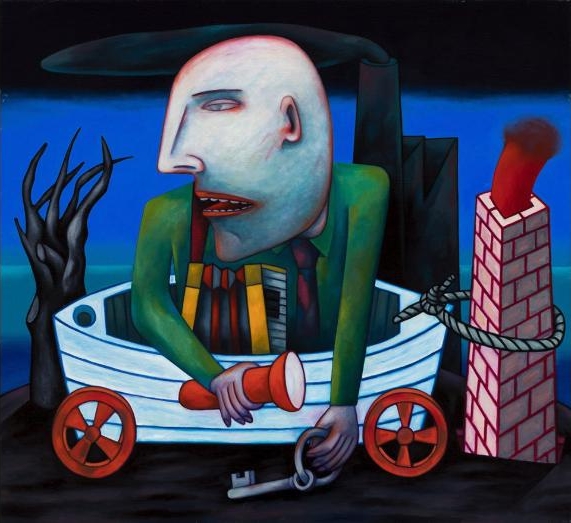
Euan Heng
[Custodian] 1989oil on canvas
Geelong Gallery
Gift of the artist, 2000
Photographer: Andrew Curtis
2000
In 2000, Geelong was discussed as a possible location for a Guggenheim modern art museum: a satellite of the New York institution. The City pledged $100,000 to the idea, which was supported by then Premier Steve Bracks and then CoGG Mayor Michael Crutchfield.
Although this plan didn’t come to fruition, Geelong Gallery has an incredible range of modern and contemporary art to share with audiences, including Euan Heng’s Custodian, which was acquired in 2000.
Heng is a Scottish-born artist who arrived in Australia in 1977. Between 1960–70 he was engaged in various occupations including four years working as a merchant seaman travelling the world, an aspect of his life that features in his works.
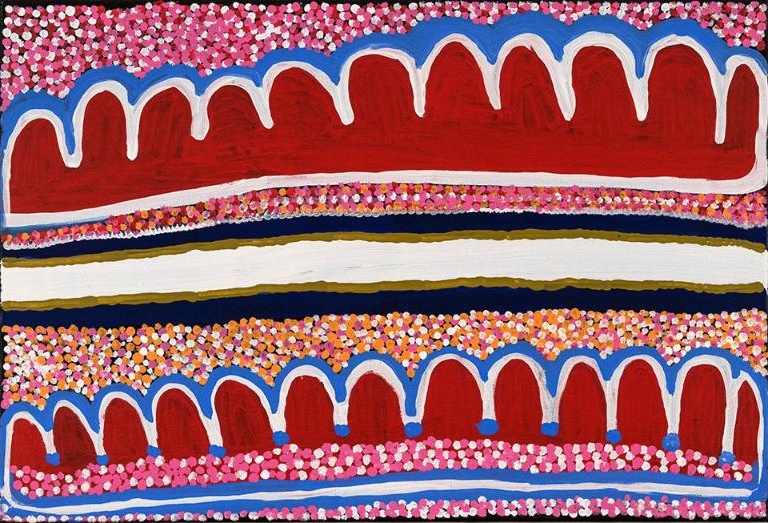
Narputta Nangala
[Puli at Lake MacDonald] 2001synthetic polymer painting on canvas
Geelong Gallery
Gift of Jim Cousins AO and Libby Cousins through the Australian Government’s Cultural Gifts Program, 2018
© Estate of Narputta Nangala licensed by Aboriginal Artists Agency
Photographer: George Stawicki
2001
In 2001, Geelong Gallery underwent renovations throughout the building. The entrance, foyer and main temporary exhibition spaces were reconfigured and modest alterations to the basement were completed to include secure storage for works of art.
Puli at Lake MacDonald by Pintupi artist Narputta Nangala was painted in 2001 and later acquired for our permanent collection in 2018.
Nangala was born in Karrkurutinytja, also known as Lake MacDonald (or Lake Macdonald), on the border of Western Australia and the Northern Territory. Puli at Lake MacDonald is Nangala’s unique vision of her Country. The repeated arched forms represent the ‘puli’ (rocks or low rocky sand hills) that surround the lake. The central bands represent the lake after the rains (blue) and the salt crystals as the lake starts to dry (white).
Please note: Aboriginal and Torres Strait Islander People should be aware that this post contains the name of a person who has since passed away.
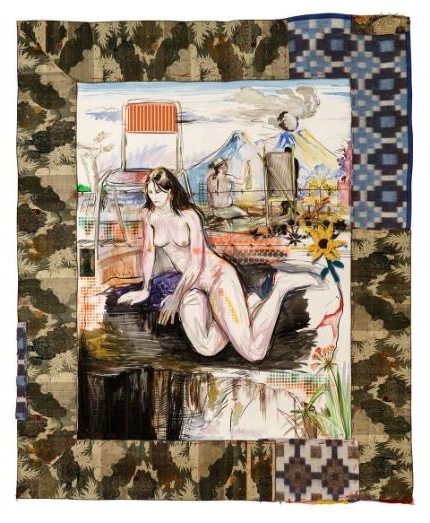
Juan Davila
[A bush burial] 2000gouache, pencil, enamel and collage on paper
Geelong Gallery
Gift of the artist, 2002
© Juan Davila, Courtesy Kalli Rolfe Contemporary Art
Photographer: George Stawicki
2002
Geelong Gallery acquired a second major work by Chilean-born Australian artist Juan Davila in 2002. Following the acquisition of the large-scale painting A bush burial in 2001, the artist gifted a second interpretation of Frederick McCubbin’s A bush burial (1890) to Geelong Gallery’s permanent collection.
Davila’s two works depict the same scene from different viewpoints. In each, he reframes the pioneering narrative of McCubbin’s earlier work, to comment on social diversity and Australia’s complex political environment (particularly in relation to refugees).
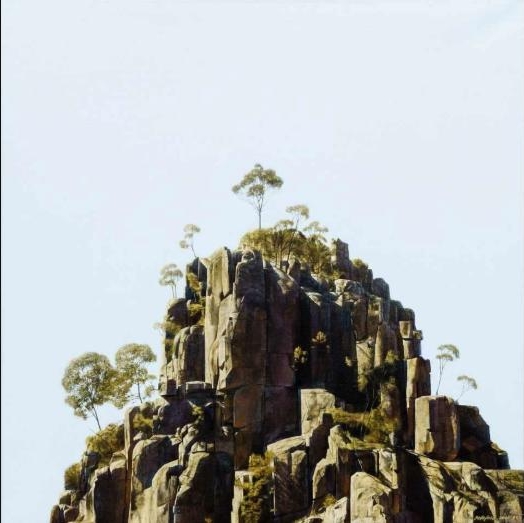
William Delafield Cook
[Peak] 1992synthetic polymer paint on canvas
Geelong Gallery
Gift of Joseph Brown, AO, OBE, 2003
Photographer: George Stawicki
2003
In 2003, well known art collector, dealer and philanthropist Dr Joseph Brown donated significant works to the permanent collection, including paintings by Howard Arkley and William Delafield Cook, and sculptures by Lenton Parr and William Ricketts.
Pictured is Delafield Cook’s Peak. This synthetic polymer paint on canvas work is typical of the artist’s meticulous observation of form, light, and his photo-realist style.
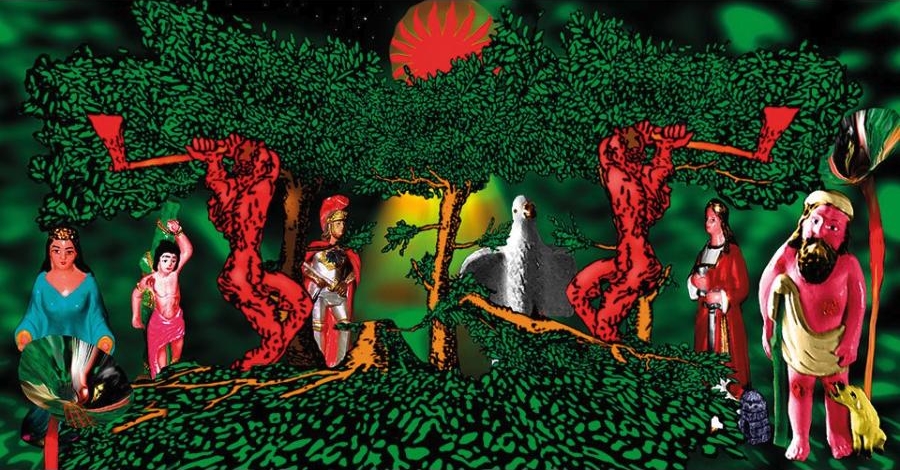
Peter Callas
[Forest clearing (sincretismo)] 1999/2004digital print on photographic paper
Geelong Gallery
Purchased with funds generously provided by the Geelong Art Gallery Foundation, 2004
2004
Thanks to funds generously provided by the Geelong Art Gallery Foundation in 2004, Geelong Gallery acquired a major digital image by Australian artist Peter Callas.
Callas is acclaimed for his pioneering video art using the Fairlight CVI (Computer Video Instrument) to create 2-dimensional digital works on paper from computer graphics.
Forest clearing (sincretismo) is one work from Callas’ Um novo tempo – reimagining Brazil series. The series, with post-colonial, political and environmental subjects, was created when Callas took several trips to Brazil, the title of this work taken from a slogan on a political poster in Manaus, Brazil.
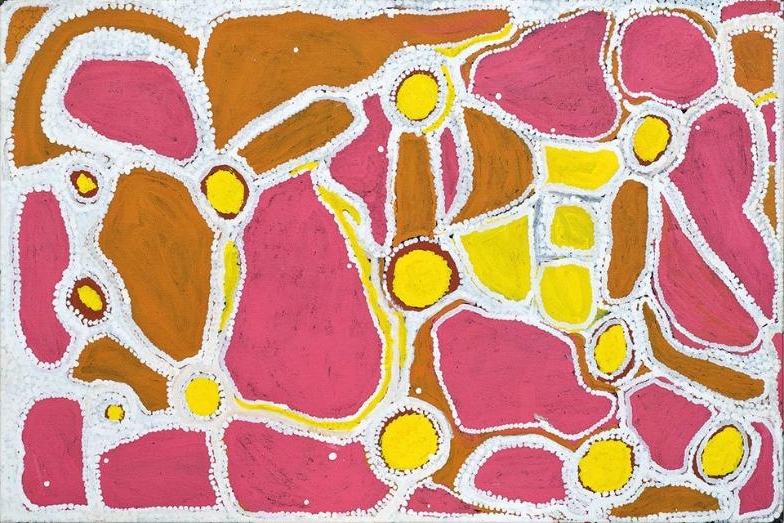
Katarra Nampitjinpa
[Untitled] 1996oil on canvas
Geelong Gallery
Gift of Jim and Libby Cousins, 2005
© Estate of Katarra Nampitjinpa licensed by Aboriginal Artists Agency
Photographer: George Stawicki
2005
In 2005, Dr Robert Edwards AO and Catherine Edwards gifted Geelong Gallery 124 pieces of breathtakingly fine, translucent Belleek porcelain giving the collection an outstanding holding of this widely collected Irish manufactory’s output.
2005 also saw our Senior Curator, Lisa Sullivan, join the Geelong Gallery team. Sixteen years later Lisa has been responsible for delivering ground-breaking exhibitions such as RONE in Geelong and Frederick McCubbin—Whisperings in wattle boughs.
Untitled by Pintupi artist Katarra Nampitjinpa joined the collection in 2005. Nampitjinpa was born on Ulkapa country and spent time at Ikuntji (also known as Haasts Bluff), a community well known as the hometown of many First Nations artists including Makinti Napanangka, Daisy Jugadai Napaltjarri and Bill Whiskey Tjapaltjarri.
Please note: Aboriginal and Torres Strait Islander People should be aware that this page contains the name of a person who has since passed away.
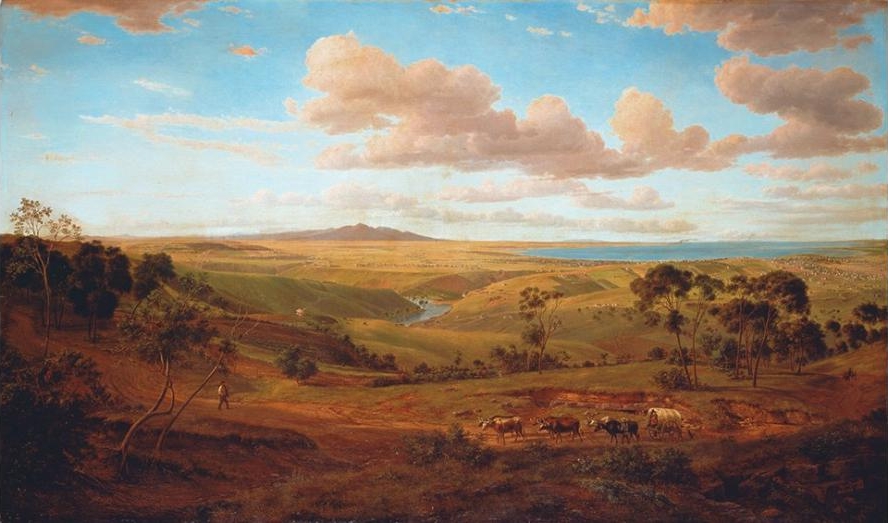
Eugene von Guerard
[View of Geelong] 1856oil on canvas
Geelong Gallery
Purchased through the Geelong Art Gallery Foundation with the generous support of the Victorian Government, the Australian Government, the City of Greater Geelong and numerous community and other donors, 2006
Photographer: Terence Bogue
2006
Purchased from Andrew Lloyd Webber through the Geelong Art Gallery Foundation with the generous support of the Victorian Government, the Australian Government, the City of Greater Geelong and numerous community and other donors, Eugene von Guérard’s View of Geelong (1856) entered the permanent collection in 2006.
The most important work acquired since Frederick McCubbin’s A bush burial (1890) in 1900, View of Geelong represents the large expanse of pastoral land and remnant bush country surrounding Geelong in 1856. In the immediate foreground a picturesque road winds around the Barwon, and is shadowed by gums, acacias, and she-oaks.
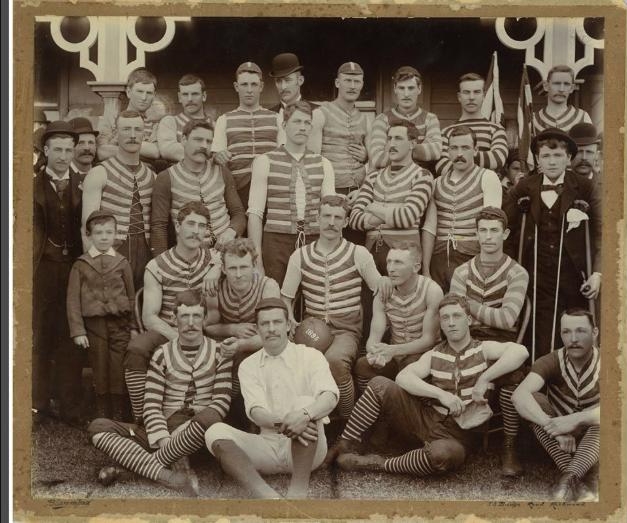
1895 team at Corio Oval
Photographer unknown
Bob Gartland collection
2007
2007 was one of the most important years in Geelong Football Club history: winning the 2007 Premiership is an event that thrilled the City and region, and heralded a stunning new phase for the Club.
The Cats kept up the momentum with their 2009 and 2011 Premiership wins, solidifying the team as one of the greatest. Take another look at this charming image from 2019 exhibition The Greatest Team of All—treasures from the Bob Gartland Collection.
This photograph is from former Cat’s Vice-President Bob Gartland’s extensive and awe-inspiring collection. It depicts the Geelong Football Club in 1895 at Corio Oval.
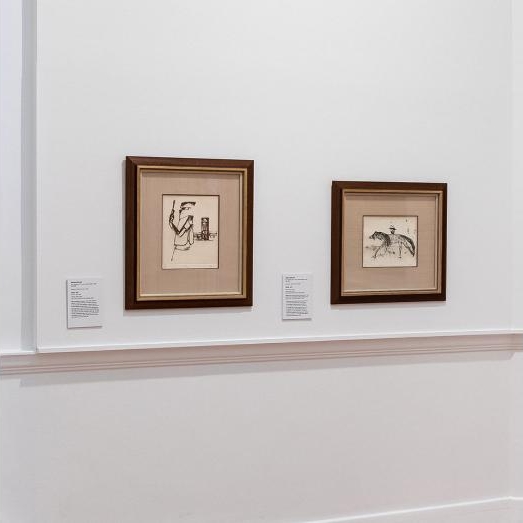
Sidney Nolan—from the collection
installation view, Geelong Gallery, 2019
works by Sidney Nolan
Photographer: Andrew Curtis Photography
2008
In 2008, Geelong Gallery held an exhibition titled True crime—murder and misdemeanour in Australian art, dedicated to popular fascination with the intrigues of true crime.
The exhibition assembled a range of artistic responses that were unsettling and sometimes down-right disturbing in their interpretation of well-documented true crime stories, personalities and perpetrators.
Australian artist Sidney Nolan’s works Kelly and Horse were gifted to Geelong Gallery by Alcoa Australia in 2008. This image is from our 2019 exhibition Sidney Nolan—from the collection.
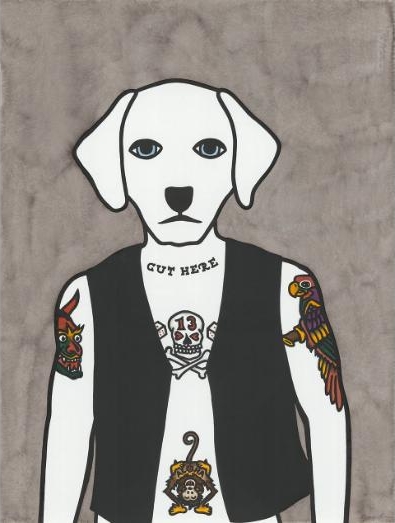
Rona Green
[The Duke] 2008linocut, ink and watercolour; artist’s proof
Geelong Gallery
Geelong acquisitive print awards (acquired), 2009
2009
Geelong Gallery made an important ‘virtual’ step in 2009. The ‘search our collection’ section of the website was launched, allowing members of the public to explore and research our extensive permanent collection.
This important feature is free to access for any member of the public (although it looks a lot different now).
Rona Green’s The Duke was acquired from the 2009 Geelong acquisitive print awards, adding to her additional works in the collection The Great White and Sheila.
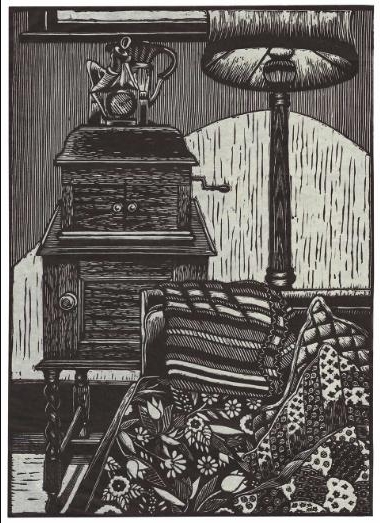
Deborah Klein
[Jazz age memories] 1985linocut on handmade paper; edition 4/25
Geelong Gallery
Gift of Conrad O’Donohue and Rosemarie Kiss, 2010
© Courtesy of the artist
2010
In 2010 Geelong Gallery held a number of enthusiastically-received and visited exhibitions, including Mary and Max—the exhibition, featuring the clay-mation models by Academy Award winning director, Adam Elliot.
Geelong Gallery was gifted a collection of various works for the permanent collection by generous and long-term local donors Conrad O’Donohue and Rosemarie Kiss, including several Honoré Daumier works and Jazz age memories, a linocut by Deborah Klein.
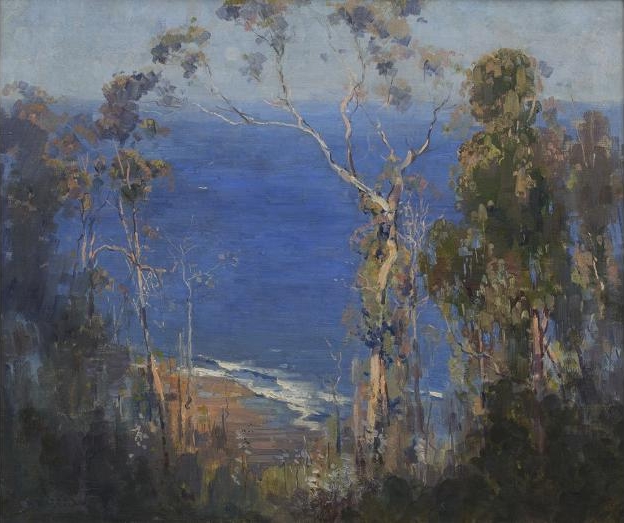
Arthur Streeton
[Ocean blue, Lorne] 1921oil on canvas
Geelong Gallery
Purchased with funds generously provided by Geelong Art Gallery Foundation, Robert Salzer Foundation Art Program, Geelong Community Foundation, Will and Dorothy Bailey Charitable Gift and numerous individual donors, 2011
Photographer: George Stawicki
2011
Arthur Streeton’s Ocean blue, Lorne (1921) was purchased in 2011 with funds generously provided by Geelong Art Gallery Foundation, Robert Salzer Foundation Art Program, Geelong Community Foundation, Will and Dorothy Bailey Charitable Gift and numerous individual donors.
Born in Mount Duneed, Streeton spent several years exploring the world before returning to Australia and reconnecting with the local landscape. During the summer of 1921, he completed at least five paintings of Lorne, one of our Surf Coast’s most popular places and tourist destinations.
Streeton thought so highly of Ocean blue, Lorne that it was retained in his family’s possession for decades and, in 1935, featured it in a deluxe publication of his finest works.
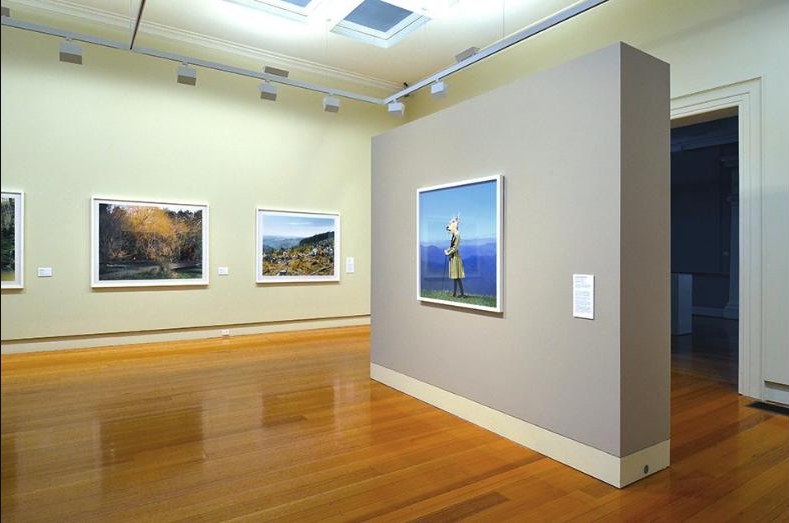
A curious nature
installation view, Geelong Gallery, 2012
works by Siri Hayes and Polixeni Papapetrou
Photographer: George Stawicki
2012
In 2012 Geelong Gallery presented A curious nature—the landscape as theatre in contemporary photography and new media, an exhibition of still and moving images in which the landscape — in its natural and urban forms, or as depicted in painted backdrops — is the setting for performative actions, often of a peculiar or absurdist nature.
The exhibition included works by Kate Bernauer, Siri Hayes, Gabriella Mangano and Silvana Mangano, Polixeni Papapetrou, Jacqui Stockdale, and Christian Thompson.
The landscape genre holds an enduring and respected position within the art histories of Western civilisations. It is a powerful and constantly revised cultural construct that differs fundamentally from the sense of belonging to land and Country that shapes the lives of many Indigenous cultures.
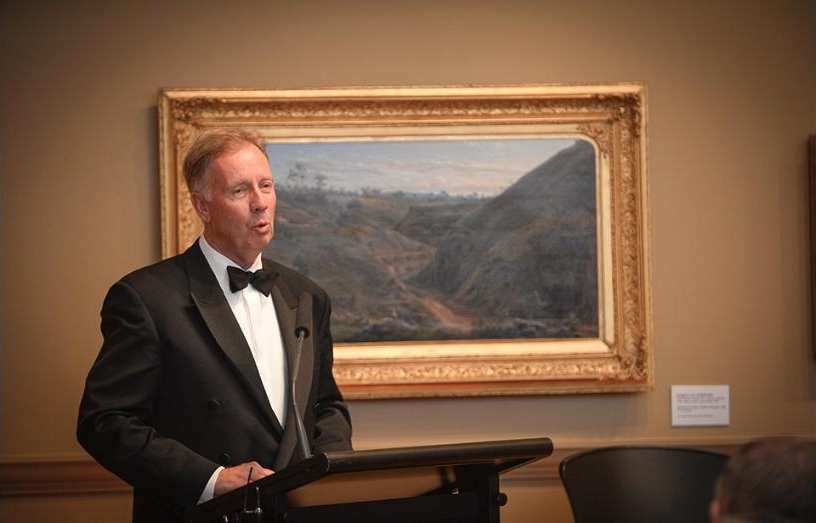
Geoffrey Edwards farewell board dinner
Geelong Gallery 2016
work by Eugene von Guerard
Photographer: Reg Ryan
2013
In 2013, Director Geoffrey Edwards recorded a video for Culture Victoria in which he provided a collection overview and insights to key works.
With over 6000 works from historical to contemporary, encompassing a diverse array of materials and techniques, and numerous countries of origin, the collection provides countless research threads to follow.
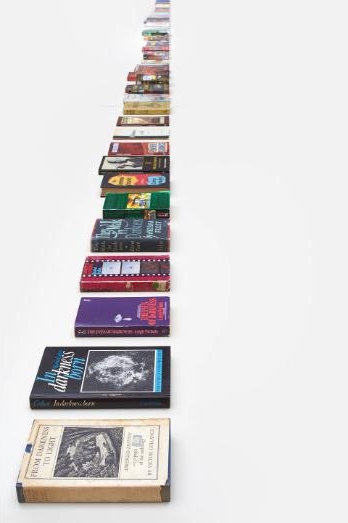
Ex libris—the book in contemporary art
installation view, Geelong Gallery, 2014
work by Patrick Pound
Photographer: Jeremy Dillon
2014
In 2014, Geelong Gallery curated exhibition Ex libris—the book in contemporary art brought together works by artists Chris Bond, Penelope Davis, Danny Digby, Nicholas Jones, Aliza Levi, Tom Nicholson, Patrick Pound, and Kylie Stillman.
Each artist manipulated the book form, re-purposing, re-interpreting and investing new life into mostly old and second-hand volumes or titles. At a time when the future of printed books was brought into question in relation to technological advancements, artists were increasingly engaging with the physical form of publications.
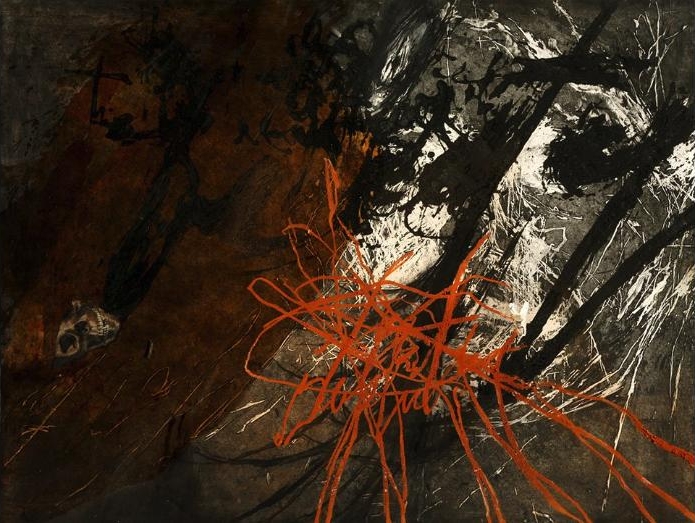
Sophie Cape
[The devil’s firmament] 2014etching and collagraph, charcoal, oil, collage, shellac and soil
Geelong Gallery
Geelong acquisitive print awards (winner), 2015
Courtesy of the artist
2015
2015 was one of the busiest years for Geelong Gallery in its history. Celebrating 100 years since the opening of the George Michelmore Hitchcock Memorial Art Gallery, Geelong Gallery staged the exhibition 1915 revisited – a collection in residence to explore the history of the building and the key acquisitions that were part of the collection at the time. A contemporary sculptural response to the architecture of the building by artist Lisa Young was also commissioned, titled Framework.
The Geelong Gallery Foundation established the Hitchcock Society to acknowledge the generous support provided by philanthropists during Geelong Gallery’s formative years, and those who more recently, have supported Geelong Gallery through bequests.
2015 was also an exciting year for Geelong’s cultural precinct with the opening of the Geelong Library and Heritage Centre, and the addition of a Temporary Exhibitions space for Geelong Gallery, which has since hosted a number of acclaimed exhibitions.
Australian artist Sophie Cape won the 2015 Geelong acquisitive print awards with her work The devil’s firmament.
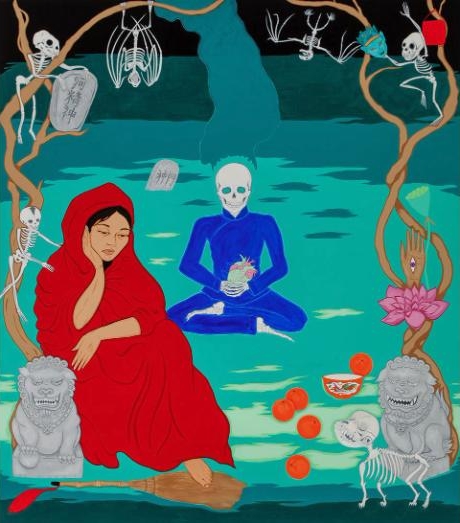
Kate Beynon
[Graveyard scene / the beauty and sadness of bones] 2014–15synthetic polymer paint on canvas
Geelong Gallery
Geelong contemporary art prize (winner), 2016
Courtesy of the artist
2016
In 2016 our Director and CEO, Jason Smith, assumed his position and Geelong Contemporary was formed, bringing many fundraising events to our annual program.
2016 also saw the introduction of Geelong Gallery’s first ticketed exhibition, Land of the Golden Fleece—Arthur Streeton in the Western District, which was the final exhibition curated by Director Geoffrey Edwards, concluding his 16-year tenure at Geelong Gallery.
Geelong Gallery became the custodian of the outstanding Colin Holden Collection of Australian and international prints on behalf of the Colin Holden Charitable Trust.
Artist Kate Beynon won the 2016 Geelong contemporary art prize for her work Graveyard scene / the beauty and sadness of bones, which featured in our 2020 exhibition Collection leads: Kate Beynon—kindred spirits.
2017
In 2017 Geelong Gallery hosted the 2017 Archibald Prize, which attracted 58,270 visitors.
Deputy Director, Penny Whitehead, joined Geelong Gallery in 2017. Whitehead shares wealth of knowledge in areas such as marketing, sponsorship and communications strategies.
Dianne Fogwell was the recipient of the 2017 Geelong acquisitive print awards and Clare Humphries was the winner of the Ursula Hoff Institute award. For the first time, an additional artist, Peter Garnick, was selected by the judging panel to undertake a 5-day printmaking residency generously provided by Queenscliff Gallery and Workshop.
2018
In 2018 Geelong Gallery received notification of a bequest from the Estate of John Norman Mann, a local resident and member of Geelong Gallery along with his wife Bette.
The bequest provided funds for the acquisition of works by contemporary Indigenous and non-Indigenous Australian artists. Among the initial acquisitions were works by Simone Slee, Adam Pyett and Brett Colquhoun.
In the following year, the bequest funds were directed to the acquisition of two works by Dhuruputjpi artist Ms Wirrpanda, Gipipi and Gipipi/Warrapal/Yananu.
The 1874 Geelong Gold cup was also acquired for the permanent collection, adding to Geelong Gallery’s holdings of metalwork by pre-eminent Geelong-based silversmith Edward Fischer.
Please note: Aboriginal and Torres Strait Islander People should be aware that this post contains the name of a person who has since passed away.
2019
Geelong Conservation was established in 2019, with a focus on fundraising events that provide special access to people and places not always readily available to the public.
Funds raised by Geelong Conservation to date have contributed to the conservation of Clarice Beckett’s Rainy day (1930), Walter Withers’ Moonrise on the Yarra (1908) and Danila Vassilieff’s An accident I saw (1948) and You Yangs with car (1938).
In 2019, Injinoo artist Teho Ropeyarn won the 2019 Geelong acquisitive print awards for his work Lukuyn – Apudthama. According to the artist, the work emphasises the ancestral connection that maintains the strength of the four Injinoo clans who have lived on traditional lands for thousands of years. The four clans are represented by the four large red male ceremonial ‘U’ shaped markings.
2020
In 2020, the COVID-19 pandemic saw Geelong Gallery close its doors for extended periods for the first time since the current building opened in 1915. Excluding closures for expansion or renovation, the only other period when visitation was restricted was during the Spanish Flu in 1919.
Despite the challenges of the pandemic, a host of incredible exhibitions continued online and in-person when restrictions were lifted.
Among these was Jacky Redgate—HOLD ON, Kate Beynon—kindred spirits and Scenic Victoria—Land, sea, city, all available to explore in the Geelong Gallery virtual space.
In early 2020 Geelong Gallery hosted The Look, a touring exhibition from Canberra’s National Portrait Gallery. Open for less than 2 weeks, The Look included photographic portraits of extraordinary Australians from a diverse array of fields including theatre, sport, art, music, fashion, literature, film, and more.
2021
We now turn our focus to the future. All great cities have great galleries.
Geelong Gallery has recently delivered a Business Case to the City of Greater Geelong Council and the Victorian State Government for the redevelopment and expansion of the Gallery. Our vision is to realise a 21st-century regional gallery of state significance—an expanded Geelong Gallery that drives creative thinking and attracts and inspires the people of Geelong and communities across Victoria.
Located in one of Australia’s fastest growing regional cities, an expanded Geelong Gallery will provide a transformative experience, one that connects art to community, and strengthens Geelong’s civic pride, identity, confidence and sense of purpose. An expanded Geelong Gallery will unlock the City’s creative potential, giving tangible form to Geelong as the only UNESCO City of Design in Australia, and enable an uplift in tourism that revitalises the health of our regional economy.
We continue to advocate to all levels of government for their support of this project.
